Florence Porta Romana: What to See in a Neighbourhood That Works
Discover Florence Porta Romana, what to see beyond the tourist trail: the intact medieval gate, the Boboli's quieter southern entrance, local bars, and.
A neighbourhood that still functions as one
Porta Romana sits at the southern edge of the Oltrarno district, at the point where the 14th-century city walls met the road to Siena and Rome. It is the area in Florence where the transition between the historic centre and the working city is most clearly visible. The medieval gate is still there. Local bars serve coffee to university students and office workers. The Boboli Garden has a southern entrance here that almost no one uses.
The neighbourhood is not designed for tourism. It does not have a concentration of restaurants aimed at visitors, a cluster of souvenir shops, or an obvious attraction that puts it on the standard itinerary. What it has is a character that is increasingly rare in the historic centre: functional, inhabited, and proportionate to the lives of the people who live and work in it.
A half-day here, combined with a visit to the Boboli Garden from the quieter southern entrance, gives a perspective on Florence that the museum circuit does not offer.
Porta Romana: the only intact medieval gate
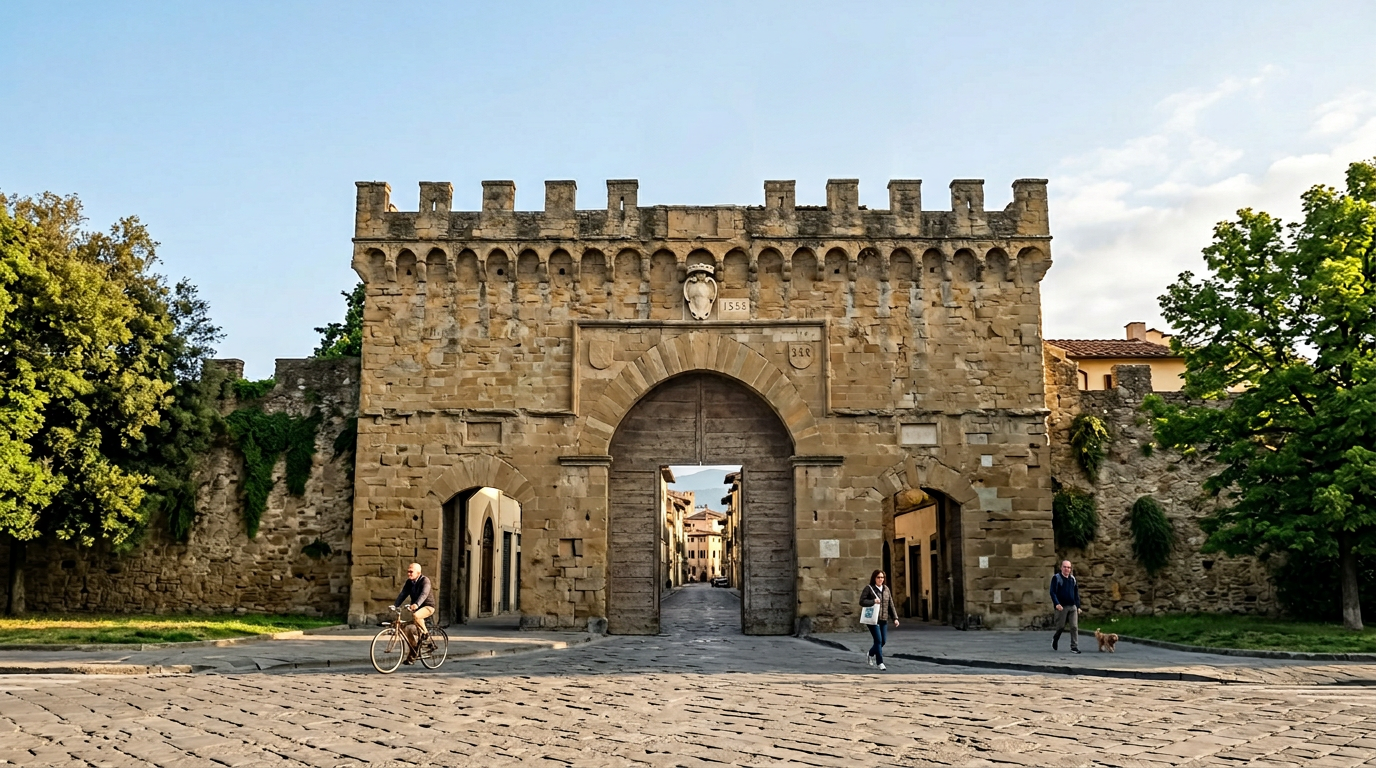
The Porta Romana is the best-preserved city gate in Florence and the only one that survives essentially complete. It was built between 1326 and 1328 as part of the expansion of the city walls under Angevin rule, intended to accommodate a city that had grown significantly beyond the previous wall circuit.
The structure is 13 metres high. Two fortified towers flank a central arched passage. On the inner face of the arch, above the opening, a 14th-century fresco of the Madonna with Child has survived centuries of exposure in partial form. The outer face retains the original groove for the portcullis, visible if you look up at the underside of the arch as you pass through.
The surrounding wall circuit, of which Porta Romana was one part, extended across the south of the city and connected to the Arno on both sides. Most of it was demolished beginning in the 1860s, when Florence served briefly as the capital of the newly unified Italian state and the city was modernised under a plan that widened roads and cleared medieval structures to create the ring of avenues (viali) that now marks the perimeter of the historic centre. Porta Romana survived because the avenue it anchors, Viale del Poggio Imperiale, remained a significant road and the gate’s visual presence was considered worth preserving.
You can walk through the gate freely at any time; it sits on a functioning road. To understand its scale properly, stand on the south side and look north through the arch toward the city. The tree-lined avenue of Viale Niccolò Machiavelli recedes toward the centre, and the gate frames the perspective. The view has changed less than most things in Florence since the 19th century.
The small church of Santa Maria della Calza stands immediately beside the gate. It dates from the 15th century and contains a fresco cycle by Franciabigio. It is not reliably open, but when it is, entry is free and the space is almost always empty.
The Boboli Garden from the south entrance
Most visitors to the Boboli Garden enter from the Palazzo Pitti side, which is the northern entrance and the most trafficked access point. The southern entrance at Porta Romana is a different experience: less crowded throughout the year, physically different in what you see first, and useful if you want to move through the garden from the bottom to the top rather than descending from the palace and retracing your steps.
Entering from Porta Romana, you arrive at the lower section of the garden near the amphitheatre. The walk to the upper sections involves a 20 to 30 minute climb on gravel paths with moderate elevation change. Along the route, you pass through cypress alleys, past statuary groups placed at intervals across the garden, and eventually reach the Kaffehaus pavilion, a small 18th-century building with a terrace that offers a view over the city at garden height.
Hours for the Boboli are daily from 08:15 to a seasonal closing time: approximately 18:30 in September, 17:30 in October and November. The garden is closed on the first and last Monday of each month. Entry costs 10 euros for adults, or 22 euros for the combined Palazzo Pitti ticket that includes all three museums in the complex. The Porta Romana entrance uses the same ticket as the Pitti entrance.
One practical advantage of arriving from this side: queues at the Pitti entrance in summer can be substantial from about 10:00 onward. The Porta Romana entrance typically has no queue at all, even on busy days. If you find the Pitti entrance busy, the 15-minute walk south to the alternate entrance is almost always worthwhile.
Bars, cafes, and places to eat
The immediate area around Porta Romana has a concentration of small bars and cafes that serve a local rather than tourist-facing clientele. These are places where university students from the nearby faculties of the University of Florence stop for coffee between lectures, where neighbourhood residents take their morning cornetto, and where workers break from office routines.
On and around Piazza della Calza and Via Romana, there are half a dozen small bars within a 5-minute walk. Standing espresso prices here are close to standard Florentine rates: 1.20 to 1.50 euros at the counter. A cornetto is approximately 1.20 euros. These prices are typically 20 to 40 percent lower than the equivalent at tourist-facing bars near the Uffizi or Piazza della Signoria.
Via Romana, the street running north from the gate toward Piazza Pitti, has a mixed character. There are trattorias with fixed-price daily lunch menus, alimentari (small grocery shops) selling prepared foods and local produce, and a few more tourist-facing restaurants. For an inexpensive lunch close to the Boboli Garden, this street is practical.
Outdoor seating at the local bars and cafes in this neighbourhood runs from approximately April through October. In the late afternoon, before heading back toward the city centre, these tables draw a relaxed mix of post-garden visitors and post-university students. The aperitivo hour here is quieter and less expensive than the equivalent on the north bank of the Arno.
Getting here from Oltrarno and from the centre
Porta Romana is about 1.2 kilometres south of Piazza Pitti, the heart of the Oltrarno district. The most direct route from Piazza Pitti is along Via Romana, which runs straight south to the gate. The street is friendly for pedestrians in the morning and carries moderate traffic through the day. Walking time is approximately 15 minutes at a comfortable pace.
A more interesting alternative from Piazza Pitti: walk south along Via Toscanella, turn onto Via del Campuccio, and approach the gate from the east through Piazza della Calza. This route passes through quieter residential streets and gives a better impression of the neighbourhood’s everyday character than the more direct road.
From Santa Maria Novella station, buses 11 and 36/37 run south through the city to the Porta Romana area. Journey time is approximately 15 to 20 minutes from the station. The nearest stop is on Viale del Poggio Imperiale, just south of the gate.
For visitors staying north of the Arno near Santa Croce, the walk from that neighbourhood across the Ponte alle Grazie and south through Oltrarno to the gate takes about 35 to 40 minutes. The route passes through some of the most interesting residential streets in the Oltrarno and provides a complete cross-section of the city from the Santa Croce basilica to the southern wall.
Where to Stay in Florence
The Key is at Via Cittadella 22, five minutes on foot from Santa Maria Novella station in Florence. From the guesthouse, Porta Romana is reachable in about 20 minutes by bus using line 11 or 36, or in 35 to 40 minutes on foot across the historic centre and through the Oltrarno district. The walk through the centre to the southern gate gives a complete ground-level picture of how the city transitions from tourist Florence to residential Florence. Full details at The Key.