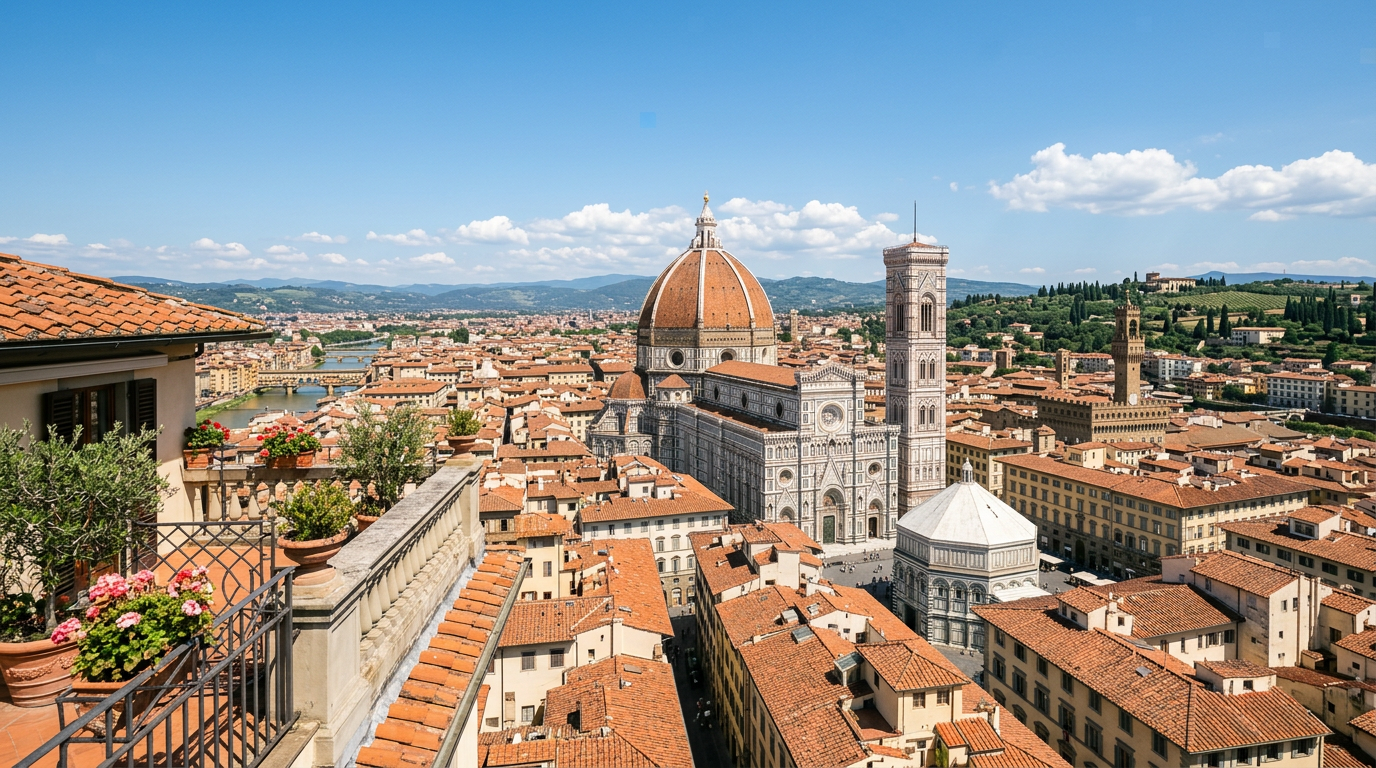
Florence in 3 Days: A Day-by-Day Guide to What to See
A practical guide to Florence in 3 days what to see, with opening hours, prices, walking distances and the best order for visiting each neighbourhood.
Three days in Florence is the right amount of time to feel like you actually understood the city rather than just checked the boxes. You can visit the Duomo complex, both major museums, the Oltrarno neighbourhood, and still have half a day to follow something that interests you personally, whether that is a specific church, a lesser-known museum, or simply the pleasure of walking without a schedule.
The practical requirement is advance planning for two things: your Uffizi ticket and your Accademia ticket. Both require timed entry. Between April and October, same-day availability is unreliable. Book before you travel. Everything else on this itinerary can be done without advance reservation.
The right structure for 3 days
The most common mistake in Florence is clustering too much into a single day. Trying to do the Duomo and the Uffizi on the same day, for example, leaves you exhausted and not fully present for either. Spacing things out is the key to actually absorbing what you see.
Day 1 covers the historic centre: the Duomo area, Piazza della Signoria, and the Bargello. Day 2 is dedicated to the two major museums, the Accademia in the morning and the Uffizi in the afternoon. Day 3 crosses the Arno into the Oltrarno and finishes with the views from the hills south of the river.
Book your Uffizi and Accademia slots for Day 2 afternoon and morning respectively. 13:00 or 14:00 for the Uffizi works well because the crowds are slightly thinner than at opening time.
Start each day before 9:00 if you can. The main squares are genuinely quieter in the early morning.
Day one: the Duomo and the centre
Arrive at Piazza del Duomo before 9:00. The Baptistery of San Giovanni opens at 9:00. Entry costs 15 euros for the Baptistery alone, but the combined Duomo Plus pass (30 euros, valid for 72 hours) includes the Baptistery, dome, bell tower, crypt, and the Museo dell’Opera del Duomo. If you plan to visit more than two of these, the combined pass is the better value.
If you want to climb Brunelleschi’s dome, book the timed slot online at operaduomo.firenze.it before your trip. The climb is 463 steps with no lift. The view from the top, 91 metres above street level, takes in the whole city and the surrounding hills. The dome was completed in 1436 and remains the largest brick dome in the world.
By 11:00, walk south along Via dei Calzaiuoli to Piazza della Signoria. This is Florence’s civic centre. The Loggia dei Lanzi at the east end of the square is free to enter and contains major Renaissance sculptures in an open arcade. Cellini’s Perseus and Giambologna’s Rape of the Sabines are both here. Take time to walk around the square rather than just passing through.
Lunch near Via dei Neri or in the Mercato Centrale area. Both have options from around 10 euros per person.
In the afternoon, visit the Bargello at Via del Proconsolo 4. It opens Tuesday through Sunday at 8:15 and costs 10 euros. The Bargello is Florence’s great sculpture museum and one of the most undervisited major sites in the city. Donatello’s bronze David, the first freestanding nude male statue since antiquity, is on the ground floor. There are also early Michelangelo sculptures and an important collection of decorative arts.
Walk along the Arno embankment in the early evening. Cross Ponte Vecchio and return via Ponte Santa Trinita. The light on the river at this hour is among the most photographed views in the city.
Day two: the two major museums
This day is devoted to the Accademia and the Uffizi. It will be intense. Eat a proper breakfast.
The Galleria dell’Accademia is at Via Ricasoli 60, about 10 minutes on foot from the Duomo. It opens at 8:15 Tuesday through Sunday. Entry is 12 euros, but you should book ahead to avoid the queue. The David by Michelangelo is displayed in the central hall, the Tribuna. The statue is 5.17 metres tall, carved from a single block of Carrara marble between 1501 and 1504. The collection beyond the David is smaller than most visitors expect. Plan 45 minutes to 1 hour for the full visit.
Have a light lunch near Piazza San Marco, which has fewer tourist restaurants than the area directly around the Duomo.
Head to the Uffizi in the afternoon. The gallery is at Piazzale degli Uffizi, about 15 minutes on foot from the Accademia. Standard entry costs 20 euros, or 25 euros during peak periods, plus a 4-euro pre-booking fee. Arrive at your booked slot time. Devote at least 2.5 hours to the visit. Rooms 10-14 hold the Botticelli collection, including the Primavera and the Birth of Venus. Room 15 contains Leonardo’s Annunciation. Room 83 holds Michelangelo’s Doni Tondo. These are the rooms most worth taking slowly.
If you have energy in the evening, walk up to Piazzale Michelangelo for the sunset. From Ponte Vecchio it is a 20-minute walk uphill, or a short ride on bus line 13. The viewpoint is free and open 24 hours. Sunset from here over the terracotta rooftops is one of the defining Florence experiences.
Day three: Oltrarno and the hills
Cross Ponte Vecchio before 9:00. The Oltrarno neighbourhood feels noticeably different from the centre: fewer tour groups, smaller streets, local bakeries that have operated in the same buildings for decades.
Walk to Piazza Santo Spirito. The basilica of Santo Spirito at number 30 opens at 10:00 with free admission. It was designed by Brunelleschi and is considered one of the most harmoniously proportioned church interiors in Italian Renaissance architecture. The columns and arcade are worth studying carefully.
From Santo Spirito, continue west to Palazzo Pitti. The main gallery, the Galleria Palatina, is open from 8:15 and costs 16 euros. It contains major works by Raphael, Titian, and Rubens. The Boboli Gardens attached to the palace (entry 10 euros) are the best green space in central Florence, with fountains, statuary, and views across the city.
After lunch in the Oltrarno streets around Piazza della Passera, walk up to San Miniato al Monte. From Piazzale Michelangelo the walk takes about 10 minutes uphill. The church opens at 9:30 and is free. The Romanesque facade dates from the 11th century. The terrace in front of the church has a panoramic view of Florence that is less crowded and arguably better than the piazzale itself.
Spend your final evening back in the centre. Piazza della Repubblica has several historic cafes, including Caffe Gilli and Caffe Rivoire. A Negroni at one of these is a reasonable way to close three days in Florence.
Practical information
Florence’s historic centre is compact. The distance from Santa Maria Novella station to the Uffizi is about 1.5 km, roughly 18 minutes on foot. You will not need a bus for any of the routes in this guide.
The ZTL restricted traffic zone covers the entire historic centre. If you arrive by car, park in peripheral car parks and use the tram or walk in. Driving inside the ZTL results in automatic fines starting at 80 euros.
Tram line T1 connects the airport and the outer suburbs to the city centre, with the main stop at Alameda. From Alameda to the Duomo is about 10 minutes on foot.
ATAF buses cover routes outside the walkable centre. A single ticket costs 1.70 euros if bought in advance at a tabacchi or via the app, or 2.50 euros on board. A day pass costs 5 euros.
Restaurant reservations are strongly recommended for Saturday and Sunday evenings. Most Florentine trattorias are small.
Where to stay during your 3-day visit
The right accommodation makes a three-day itinerary significantly more comfortable. The Key is at Via Cittadella 22, a 5-minute walk from Santa Maria Novella station. Every sight on Day 1, Day 2, and Day 3 is within easy reach on foot from this address.
Full details at The Key.