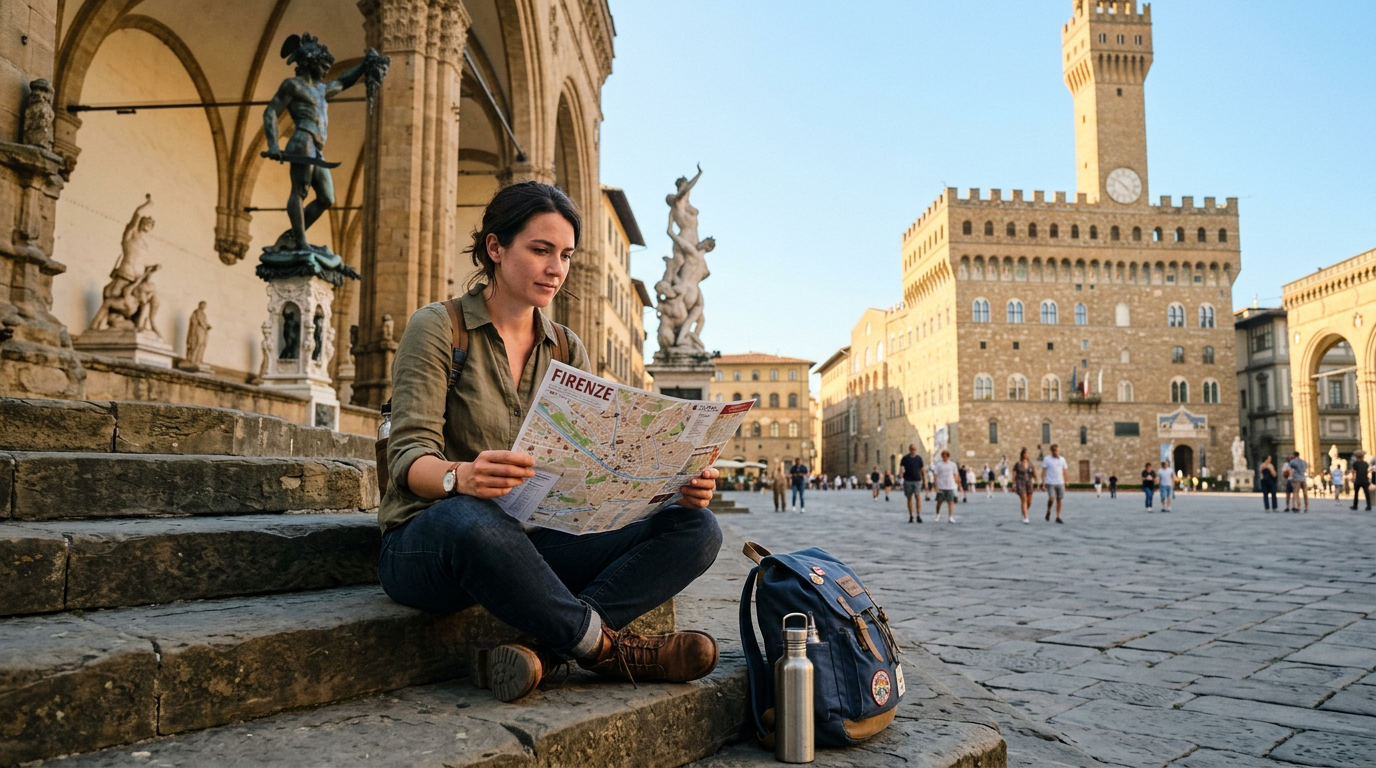
Your Complete Florence 2 Days Itinerary: A Room-by-Room Plan
Plan your Florence 2 days itinerary with confidence: real walking times, museum booking tips, where to eat and what to prioritise on each day.
Two days in Florence sounds tight, but it is more than enough to visit the essential sites, eat well, and still leave with the feeling that you understood the city. The secret is deciding in advance what matters and committing to that plan rather than trying to improvise.
Florence’s historic centre is smaller than most visitors expect. The distance from the main railway station to the Uffizi is roughly 1.5 km. From the Duomo to Ponte Vecchio is about 900 metres. Everything you need is within walking distance. You will cover around 10-14 km each day, so comfortable footwear is a genuine necessity, not just advice.
Book the Uffizi and the Accademia before you travel. Both require timed-entry tickets purchased in advance, especially from April through October when demand is highest. Walk-up admission is sometimes possible, but queues can stretch to 60-90 minutes and entry is not guaranteed.
Making the most of limited time
The advantage of Florence’s compact layout is that you lose very little time moving between sights. You do not need a bus to get from the Duomo to the Bargello. You do not need a taxi from Piazza della Signoria to Ponte Vecchio. Every major monument is reachable in under 20 minutes on foot from the centre.
The trade-off is that two days forces choices. You can visit the Uffizi and the Accademia if you plan carefully, but doing both well requires an early start on at least one of the days. If you try to add the Palazzo Pitti, the Bargello, and a hill climb in the same 48 hours, you will end up rushing through each one. Better to do three things properly than six things quickly.
Prioritise by personal interest. If you came for Michelangelo, the Accademia is non-negotiable. If you came for a broader survey of Renaissance painting, the Uffizi is the better use of a museum afternoon. If you care more about architecture than collections, the Duomo complex, San Miniato al Monte, and Orsanmichele will give you as much as any gallery.
Day one: the heart of the city
Start at Piazza del Duomo no later than 8:30. The square is noticeably quieter before 9:30. The Baptistery of San Giovanni opens at 9:00 and costs 15 euros as a standalone ticket. If you have the combined Duomo Plus pass (30 euros, valid 72 hours), the Baptistery is included, as are the dome, bell tower, museum, and crypt.
The dome climb is worth it if you booked in advance. It involves 463 steps with no lift. The view from 91 metres is 360 degrees, taking in the Arno, the Tuscan hills, and every major landmark of the city. If the dome slots are sold out, the Campanile (414 steps) offers a comparable panorama and has fewer visitors.
By 10:30, walk south along Via dei Calzaiuoli to Piazza della Signoria. Allow 20-30 minutes here. The Loggia dei Lanzi at the east end of the square is an open-air sculpture gallery with free admission. Cellini’s bronze Perseus and Giambologna’s Rape of the Sabines are displayed here alongside Roman marble works.
Lunch near the Mercato Centrale, open until midnight on the ground floor, or in the streets around Via dei Neri. Budget around 10-15 euros per person for a good sit-down meal.
Your Uffizi slot should be at 13:30 or 14:00. The gallery has 45 rooms and more paintings than you can meaningfully absorb in a single visit. Focus on rooms 10-14 for the Botticelli collection, room 15 for Leonardo, and room 83 for Michelangelo’s Doni Tondo. Plan for 2 to 2.5 hours.
Cross Ponte Vecchio around 17:00. The late afternoon light on the Arno is worth pausing for. The goldsmiths’ shops lining the bridge are less crowded at this hour than they are at midday.
Spend the evening in the Oltrarno neighbourhood, south of the river. Piazza Santo Spirito is a good base for aperitivo. A drink with a small plate typically costs 8-12 euros. Dinner in this area is better value than in the tourist-heavy streets closer to the Duomo.
Day two: the less obvious Florence
The second day is best used to see what most visitors skip.
Begin at Orsanmichele on Via dell’Arte della Lana, which opens at 10:00 with free admission. The building was originally a grain market and was later converted into a church. Its exterior niches hold statues commissioned by the major medieval guilds, including works by Donatello, Ghiberti, and Verrocchio. Many visitors walk past without going in.
From Orsanmichele, walk four minutes to the Bargello on Via del Proconsolo. It opens at 8:15, Tuesday through Sunday, and costs 10 euros. This is Florence’s great sculpture museum. Donatello’s bronze David, the first freestanding nude male figure since antiquity, is on the ground floor. There are also early works by Michelangelo and a strong collection by Verrocchio. The Bargello is consistently less crowded than the Uffizi and equally important.
If you have an Accademia ticket, head north from the Bargello to Via Ricasoli 60. The walk takes about 12 minutes. Michelangelo’s David stands 5.17 metres tall in the central hall. You have seen photographs, but the scale and detail of the original are different in person. Plan 45-60 minutes for the visit.
Lunch in the San Marco neighbourhood, which has fewer tourist restaurants than the blocks immediately around the Duomo.
In the afternoon, cross back over the Arno and walk up to San Miniato al Monte. From Ponte Vecchio the route takes about 30 minutes, gaining around 70 metres in elevation. Alternatively, bus line 13 from the Lungarno goes to Piazzale Michelangelo, from where it is a further 10-minute walk uphill to the church. San Miniato opens at 9:30 with free admission. The Romanesque interior is calm and genuinely beautiful. The terrace outside offers one of the finest views in Florence, with fewer visitors than the piazzale below.
Food notes for two days
For breakfast, do as Florentines do: stand at a bar counter and order a cornetto with a cappuccino. This costs around 2.50 euros. Sitting at a table in tourist areas can triple the price.
For lunch, the Mercato Centrale on Via dell’Ariento is reliable and reasonably priced. The first-floor food hall closes at 15:00. The ground floor market, selling leather goods and clothing, stays open until around 19:00.
For dinner in the Oltrarno, the streets around Piazza della Passera, Via di Santo Spirito, and Borgo San Jacopo have traditional trattorie. Expect 25-40 euros per person including wine.
What you can safely leave out
The interior of the Duomo is free to enter but relatively sparse compared to its extraordinary exterior. If your time is limited, the Bargello or Orsanmichele will give you more.
The souvenir shops on Ponte Vecchio are not worth queuing for. The same items are available across the city.
If it rains, skip Piazzale Michelangelo and go to the Museo dell’Opera del Duomo instead (Piazza del Duomo 9, 15 euros). It holds the original Ghiberti doors, Michelangelo’s Pieta Bandini, and Donatello’s wooden Mary Magdalene, all in a well-designed space that most visitors overlook.
A central base that saves time
Choosing where to stay affects how much you actually see. The Key is at Via Cittadella 22, a 5-minute walk from Santa Maria Novella station, which means you can walk out the door and reach Piazza del Duomo in under 15 minutes. No transit time wasted, no taxis needed to start or finish each day.
Full details at The Key.