Florence Legends and Stories: Myths, Ghosts, and True Events
Explore the Florence legends and stories that shaped a city: haunted palaces, secret corridors, conspiracies, and historical events too strange to believe.
A city built on remarkable stories
Old cities attract stories the way stone walls attract moss. Some tales begin as documented fact, circulate through families and neighbourhoods for generations, and arrive in the present wearing the costume of myth. Others start as pure invention and accumulate so many retellings that they develop a surface texture indistinguishable from history.
Florence sits at the intersection of both kinds of narrative. The city endured plague, war, political assassination, dynastic ambition, religious upheaval, and catastrophic flooding across six centuries of intense recorded history. That depth of material means there is almost no need for embellishment. The documented events are strange enough. And yet embellishment has happened anyway, layering legend over record until the two become almost impossible to separate.
This guide separates them where possible. It covers the most persistent legends of Florence, the ghost traditions, the tunnel myths, the conspiratorial whispers attached to the Medici, and it also covers several true events that have all the qualities of fiction. Knowing which is which matters, because it tells you something about how the city sees itself.
The haunting of Palazzo Vecchio
Among all the sites in Florence linked to ghost traditions, Palazzo Vecchio draws the most attention. The building served as the seat of government from the 13th century onward and doubled as a place of detention. Prisoners were held in the Alberghettino, a cluster of cells occupying the upper floors. Notable figures died within these walls, and the public square in front of the palace was the site of numerous executions.
The ghost most commonly described in folk tradition is a young man in Renaissance clothing who appears in the Salone dei Cinquecento, the vast ceremonial hall commissioned during Savonarola’s brief rule over Florence and completed in 1495. Witnesses in successive centuries described a figure who stood near the painted walls, turned, and was gone before anyone could approach.
The most dramatic confirmed occupant of those cells was Savonarola himself. The Dominican friar who had preached against Medici luxury and burned artworks in the Piazza della Signoria was arrested in 1498, held in the palace, and burned alive in the same square where he had organised his Bonfires of the Vanities. The symmetry of his execution site was not accidental.
No systematic documentation of ghost sightings exists. But the building’s layered history of violence and political detention has generated enough genuine drama that the legends feel less like invention and more like emotional residue.
Palazzo Vecchio is open Monday to Wednesday and Friday to Sunday from 09:00 to 19:00, and Thursday from 09:00 to 14:00. Admission is 12.50 euros for adults.
The Vasari Corridor and its secrets
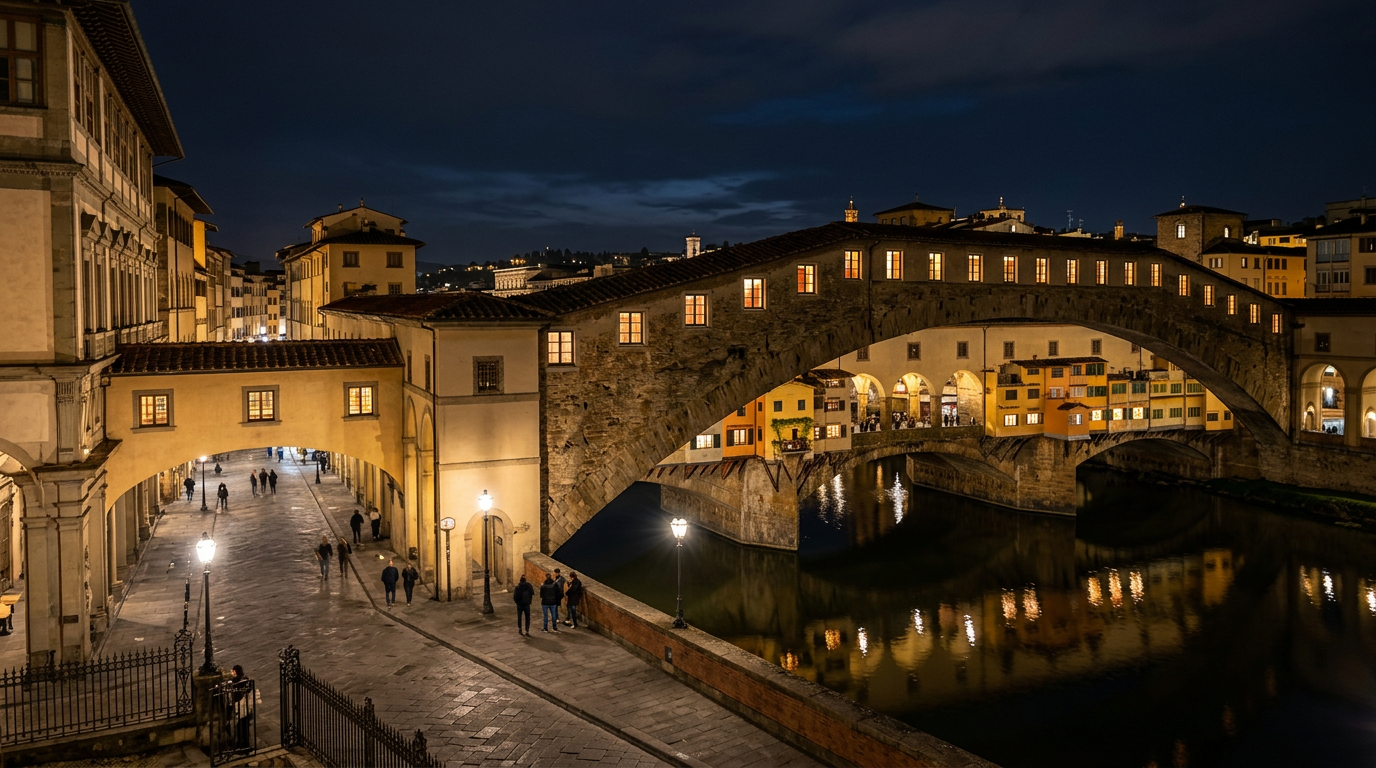
The Corridoio Vasariano is a 1-kilometre elevated passage built in 1565. Cosimo I de’ Medici commissioned it to connect Palazzo Vecchio, the seat of government, to Palazzo Pitti, his private residence, without requiring the Grand Duke to descend to street level and expose himself to the crowds.
Giorgio Vasari, the architect and author of the famous Lives of the Artists, designed and completed the structure in just five months. The corridor runs through the Uffizi building, over the shops of Ponte Vecchio via a dedicated upper level, through several private buildings in Oltrarno, and terminates at Palazzo Pitti.
The documented function of the corridor is clear. What surrounds it in popular narrative is considerably murkier. One persistent claim holds that the corridor served as an emergency escape route during political crises, allowing the Medici to exit the city through the Oltrarno side of the Arno without passing through the streets. Whether it was ever used in this way is not recorded anywhere reliable.
Another tradition suggests the corridor contained listening posts from which members of the Medici household could overhear conversations in the rooms below. This is architecturally plausible in certain sections. It is not documented.
What is confirmed: the corridor housed part of the Medici art collection, was damaged by the 1944 bombing of Ponte Santa Trinita, and suffered further damage in the 1993 Uffizi bombing linked to the Sicilian Mafia. It currently contains over 700 artist self-portraits from the 15th century to the 20th century, among the largest such collections in the world.
The corridor reopened to guided public visits in 2021. Current access requires booking through the Uffizi, costs approximately 30 to 35 euros including the Uffizi admission, and takes place in small groups with a guide.
Tunnels beneath the city
Florence stands on geological layers that include Roman drainage channels, medieval cellars, and the foundations of structures that were demolished and built over across many centuries. Beneath several piazzas and major buildings, subterranean spaces survive in various states of accessibility.
The most visible example is beneath the Duomo itself. The early Christian cathedral of Santa Reparata, which preceded the current building and was demolished when construction of Santa Maria del Fiore began in 1296, survives partially intact under the cathedral floor. Entry is included in the combined cathedral ticket (approximately 18 euros). Descending below the current floor level, you walk through walls from the 4th through the 12th century, each construction phase visible in the different stonework.
The Piazza della Repubblica was created in the late 19th century by demolishing the old Mercato Vecchio and the historic Jewish ghetto. Excavations for the piazza uncovered Roman-era structures beneath the medieval layers. Some of these are periodically accessible through guided archaeological tours.
Tourist folklore sometimes describes a network of connected tunnels under the city, linking palaces and escape routes in a continuous underground system. The reality is fragmented: individual cellars, cisterns, and foundation voids that are not connected and mostly not accessible. Legitimate guided tours visit specific subterranean spaces near Santa Maria Novella and around the Piazza della Repubblica, and these are genuinely interesting for anyone drawn to urban archaeology.
Facts more remarkable than legend
The most extraordinary material from Florence’s history requires no embellishment at all.
The Pazzi Conspiracy of 1478 was planned with meticulous precision. The Pazzi family and their allies intended to assassinate Lorenzo and Giuliano de’ Medici simultaneously during High Mass in the Duomo on Easter Sunday. Two separate groups of killers struck at the moment of the Elevation of the Host, when the congregation was expected to bow their heads. Giuliano was stabbed 19 times and died on the floor of the cathedral. Lorenzo, who received only a shoulder wound, drew his sword, retreated behind his companions, and locked himself in the sacristy behind the heavy bronze doors. The conspiracy had counted on the city rising against the Medici. Instead, Florence turned on the Pazzi. Most of the conspirators were captured and hanged from the windows of Palazzo della Signoria within days. The Archbishop of Pisa, who had been involved in the plot, was hanged in his full ecclesiastical vestments.
The 1494 expulsion of the Medici was followed immediately by the looting of Palazzo Medici. A crowd entered the building and carried away decades of collected art, furniture, and treasures in a matter of days. The household objects, tapestries, and portable works that Cosimo, Lorenzo, and their heirs had assembled across 60 years of deliberate patronage were dispersed almost entirely. The pieces that survived, including certain sculptures Michelangelo had made while living with the household, did so by chance.
The flood of November 1966 reached 6 metres above normal water level in parts of the Oltrarno. It destroyed or damaged approximately 14,000 works of art and 1.5 million books and manuscripts in the Biblioteca Nazionale. It mobilised a generation of conservators and volunteers from across the world who became known as the Mud Angels. Modern techniques of flood conservation were developed in direct response. The watermarks from that event remain visible today on several buildings near the Uffizi and Santa Croce, sitting roughly 2 metres above the current pavement level.
Where to Stay in Florence
The Key occupies a building at Via Cittadella 22, placed five minutes on foot from Santa Maria Novella station. From there, Palazzo Vecchio and its long history of political drama is a comfortable 20-minute walk through the historic centre. The flood marks near Santa Croce, one of the most tangible reminders of how Florence has repeatedly survived extraordinary events, are about 25 minutes on foot from the guesthouse. Full details at The Key.