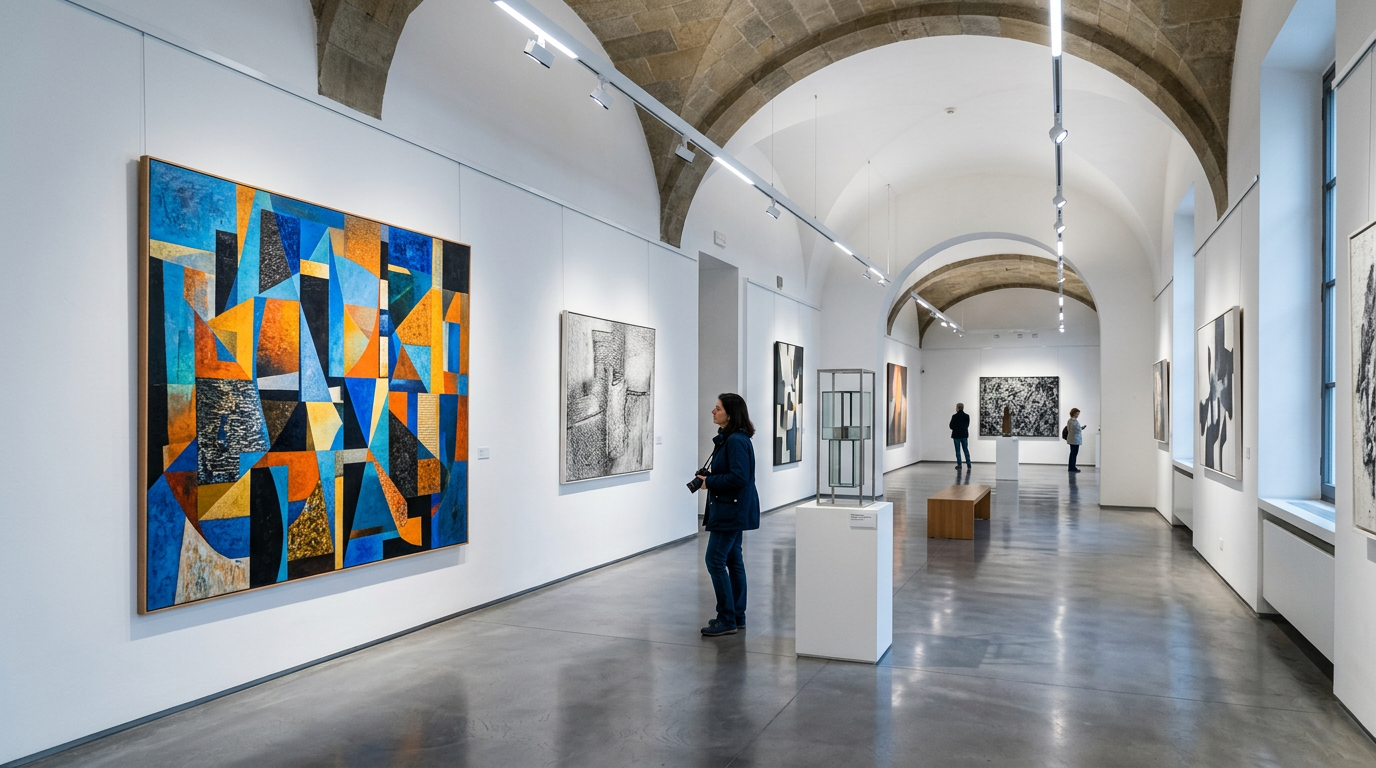
Florence Contemporary Art Galleries: Where the City Lives in the Present
A guide to Florence contemporary art galleries: the Museo Novecento, Palazzo Strozzi shows, independent spaces in the centre, and how to find what is on.
Florence outside the Renaissance
The dominant version of Florence, the one reproduced on postcards and organised into museum itineraries, covers roughly 150 years of Florentine history. The 15th and 16th centuries were the period of Botticelli, Michelangelo, Leonardo, Brunelleschi, and Ghiberti, and they were genuinely extraordinary. But they represent one chapter of a much longer story, and building an entire visit around that single chapter misses a great deal.
Florence has maintained an active cultural life throughout the centuries that followed the Renaissance. It was a centre of intellectual and political activity during the Risorgimento. It was briefly the capital of Italy. It experienced Fascism, Resistance, and post-war reconstruction. And it has, in the 21st century, a functioning contemporary art scene with public institutions, a network of independent galleries, and a significant international exhibition programme.
This guide covers the contemporary and 20th-century side of Florence’s art world. It is not exhaustive; the gallery landscape shifts regularly. It is a working framework for anyone who wants to look at art made in the last 100 years while staying in a city that is often treated as if nothing of consequence happened after Vasari died.
Independent galleries in the centre
The independent gallery scene in Florence is smaller in scale than Milan or Rome, but it is genuinely active and includes spaces with serious international programs.
Galleria Frittelli Arte Contemporanea at Via dei Pilastri 9, near the Sant’Ambrogio market, has operated since 2001. The gallery focuses on mid-career and established Italian and European artists and organises approximately 6 to 8 exhibitions per year. Entry is free. Open Tuesday to Saturday from 10:00 to 13:00 and 15:30 to 19:30.
Eduardo Secci Gallery at Piazza Goldoni 2 is among the most commercially significant contemporary galleries in the city, with an international program that moves between painting, sculpture, and works on paper. The gallery opened in Florence in 2010 and occupies a late 19th-century building with high ceilings suited to large-scale work. Open Monday to Friday from 10:00 to 19:00, and Saturday by appointment.
Galleria Giovanni Bonelli splits its activity between Milan and Florence. The Florentine program tends toward younger Italian artists and a more experimental posture than the established galleries. Because the program changes frequently, check the gallery website before visiting.
Project spaces in San Frediano and Via dei Serragli, in the Oltrarno district, represent the more informal end of the scene. Several spaces in this neighbourhood operate on event schedules rather than regular gallery hours and are most active during opening events, which typically take place on Thursday and Friday evenings. For current activity in this area, gallery Instagram accounts are more reliable than websites.
For an overview of what is on during your visit, firenzegallerie.it provides a listing of gallery exhibitions across the city. The cultural supplement of La Nazione covers openings and events in the local edition. The Florentine (theflorentine.net) maintains a reliable English-language events calendar.
Museo Novecento: Italian art from 1900 to 1980
The Museo Novecento is Florence’s dedicated public institution for 20th-century Italian art. It opened in 2014 in a space on Piazza Santa Maria Novella 10, adapted from a former annex of the Istituto degli Innocenti by the architect Adolfo Natalini. The location, directly on one of the most significant medieval piazzas in the city, is itself a curatorial statement: contemporary Italian art placed in direct physical proximity to Brunelleschi and Ghirlandaio.
The permanent collection spans the Futurist period of the early 1900s through the Arte Povera generation of the 1960s and 1970s and beyond. Three figures from the collection deserve particular mention. Giorgio Morandi, the Bologna-based painter who devoted most of his working life to a narrow range of still life subjects, bottles, jugs, boxes, in arrangements of extraordinary subtlety, is represented in depth. His work repays slow looking in a way that many more spectacular paintings do not. Carlo Carrà, one of the co-signatories of the Futurist Manifesto who subsequently shifted to Metaphysical painting under the influence of De Chirico, appears at a moment of significant transformation in Italian art. Marino Marini, whose bronze figures of riders on horseback became one of the most recognisable Italian sculptural idioms of the mid-20th century, is represented in three dimensions.
The museum’s temporary exhibition programme has in recent years focused on artists who are central to the Italian art history narrative but less visible internationally than their status warrants. These exhibitions act as a corrective to the tendency to reduce Italian modern art to the Rome-Milan-Venice circuit.
Entry costs 9.50 euros for adults. Open daily from 11:00 to 20:00, with extended hours on Friday and Saturday until 23:00. The late Friday and Saturday hours make this a viable option for a post-dinner visit on evenings when other museums are closed. The building is 5 minutes on foot from Santa Maria Novella station.
Palazzo Strozzi: the large international exhibitions
Palazzo Strozzi functions as the primary venue in Florence for major temporary exhibitions. Since 2006, the Fondazione Palazzo Strozzi has operated the building as a dedicated exhibition space, hosting between 3 and 4 large shows per year, each running for 2 to 4 months.
The programme has included retrospectives on Ai Weiwei, Cindy Sherman, Marina Abramovic, and Jeff Koons, as well as historical exhibitions examining American art, German Expressionism, and various aspects of the Renaissance tradition. This mixing of contemporary and historical reflects the building’s particular position: a 15th-century Renaissance palace operating as a meeting point between the city’s foundational art history and current international practice.
Admission varies by exhibition, typically running from 13 to 16 euros for adults. The building’s ground floor courtyard, accessible during opening hours, is sometimes used for installations or outdoor elements of the current exhibition and can be entered without a ticket. The bookshop and the cafe on the piano nobile are also accessible independently.
Hours are daily from 10:00 to 20:00, with late opening on Thursdays until 23:00. For major exhibitions, particularly those with strong international press coverage, advance booking through palazzostrozzi.org is strongly recommended. Queues for popular shows can be substantial without a pre-booked timeslot. The building is on Piazza degli Strozzi, approximately 10 minutes on foot from Santa Maria Novella station.
Keeping up with what is on
Florence’s cultural calendar is active but distributed across many channels. There is no single English-language platform that aggregates everything reliably, so useful navigation requires a small toolkit.
palazzostrozzi.org covers the full Palazzo Strozzi programme and related events with reliable advance notice of upcoming exhibitions and booking links.
musefirenze.it is the central platform for all Florence civic museums, including the Museo Novecento, Palazzo Vecchio, the Museo Stefano Bardini, and several smaller institutions. Programme information for all venues appears on one site, which simplifies planning.
The Florentine at theflorentine.net is an English-language magazine and website that covers Florence’s cultural and daily life for the international community living in and visiting the city. Weekly listings of exhibitions, events, and openings are maintained with reasonable accuracy and are particularly useful for gallery openings and smaller events not covered by the major institutions.
Arte.it is the national Italian art platform and allows Florence-specific filtering for current gallery exhibitions and museum programmes. It is useful for tracking independent gallery activity that may not appear on other sources.
For smaller and project-space events, individual gallery Instagram accounts are typically more current than official websites. Most active galleries post about openings and closings in the week they occur. Following 5 to 6 Florentine galleries before your visit gives a reasonable real-time picture of what will be open during your stay.
One timing note: the main exhibition launches tend to cluster in autumn, from September through November, and in spring, from March through May. The major institutions maintain year-round schedules regardless of season, but the independent gallery scene is somewhat quieter in July and August.
Where to Stay in Florence
The Key is at Via Cittadella 22, five minutes on foot from Santa Maria Novella station in Florence. The Museo Novecento is directly on Piazza Santa Maria Novella, a 5-minute walk from the guesthouse. Palazzo Strozzi is about 10 minutes on foot heading southeast through the centre toward Piazza degli Strozzi. Full details at The Key.