Florence Lesser-Known Churches: Four Overlooked Masterpieces
A guide to Florence lesser-known churches that most visitors walk past. Santa Felicita, Orsanmichele, San Miniato, and how to visit all four in one day.
Beyond the obvious itinerary
Florence has roughly 50 churches worth visiting. The standard tourist circuit concentrates on four or five: the Duomo complex, Santa Croce, Santa Maria Novella, and occasionally San Lorenzo or the Medici Chapels. These are not wrong choices. But they are also the most crowded, the noisiest, and in some cases the most difficult to see properly because of the volume of visitors passing through.
The churches that fall outside this circuit receive, in some cases, fewer than 20 visitors at any given time. Several contain individual works of art that rank among the most extraordinary things produced in the Renaissance. One was originally a grain market. One has been continuously cared for by the same monastic community since 1373.
What follows is a guide to four churches in Florence that are consistently overlooked. Each has specific opening hours, entry conditions, and a primary reason to visit. Together they provide a more complete picture of what the city contains than any amount of time at the Duomo complex.
Santa Felicita: Pontormo’s masterpiece
Santa Felicita stands on Piazza Santa Felicita, immediately south of the Ponte Vecchio. If you cross the bridge heading into Oltrarno and continue straight, you will reach it within two minutes. The church is one of the oldest in Florence, with origins possibly reaching to the 2nd century, though the current building dates primarily from an 18th-century reconstruction.
The entire reason to visit is the Capponi Chapel, second on the right as you enter. It contains two works by Jacopo Pontormo painted between 1525 and 1528. The Deposition from the Cross hangs as the main altarpiece. The Annunciation is on the side wall to the right.
The Deposition is one of the most technically disorienting paintings in Italian art. Pontormo rejected the rational spatial organisation that Renaissance painters from Masaccio onward had treated as a given. The figures in his Deposition exist in an undefined space: no ground plane, no architectural setting, no sky. They are arranged in a writhing composition that owes more to the emotional logic of the scene than to physical plausibility. The colours are famous: a brilliant luminous pink, a pale lilac, a sharp acid green, and a coral orange that have no precedent in the Florentine tradition. Together they produce an effect that is beautiful and deeply unsettling simultaneously.
If you have already spent time in the Uffizi looking at Mannerist painting and found it interesting, the Capponi Chapel represents that tendency pushed to an extreme. If you have not heard of Pontormo, this room is a persuasive argument that he deserves more attention than he typically receives outside Italy.
Santa Felicita is open Monday to Saturday from 09:30 to 17:30. The church itself is free to enter. The Capponi Chapel charges a small entry fee of approximately 2 euros. The chapel is lit by windows rather than artificial lighting, making morning visits on bright days significantly better for seeing the colours as Pontormo intended them.
Orsanmichele: a market that became a church
Orsanmichele on Via dei Calzaiuoli is one of the strangest buildings in Florence, and the strangeness is productive. It began as a grain loggia in the early 14th century, was reconstructed after a fire in 1337, and was formally converted into a church in 1380, without significantly altering the exterior. The result is a Gothic palace-scale building that functions as a place of worship.
The exterior is the primary draw for art historians. Each of the exterior niches was allocated to one of the major Florentine guilds, which commissioned statues of their patron saints to fill them. The resulting programme of work, carried out between roughly 1400 and 1430, involved Donatello, Lorenzo Ghiberti, Nanni di Banco, and Andrea del Verrocchio, among others. It constitutes one of the most concentrated ensembles of early Renaissance sculpture produced anywhere in a single period. The originals of most statues have been moved inside to a dedicated museum (accessible from Via dell’Arte della Lana, open Mondays only from 10:00 to 17:00, free entry) and replaced on the exterior with high-quality casts.
Inside the church, the centrepiece is the Gothic tabernacle by Andrea Orcagna, completed in 1359. It encloses a painting of the Madonna of Orsanmichele by Bernardo Daddi and is one of the most elaborately decorated objects from the 14th century in the city. The surface combines reliefs, coloured glass, marble inlay, and gold work drawn from virtually every tradition of Trecento decorative art simultaneously. It is not subtle. It is intended to overwhelm.
Entry to the main church space is free. It is open Tuesday to Sunday from 10:00 to 17:00. The building is on one of the busiest pedestrian streets in Florence and draws a fraction of the visitors of the nearby Duomo complex, principally because it does not look like a church. Most people walk past the exterior without registering that they can enter. The entrance is on the north side of the building through a door that is easy to miss.
San Miniato al Monte: the most beautiful church in Florence
San Miniato al Monte occupies the highest accessible point on the south bank of the Arno. The basilica is, by the estimation of many architects and historians, the finest Romanesque building in Italy and the most beautiful church in Florence. That judgment reflects both the quality of the building and the extraordinary completeness with which it has survived.
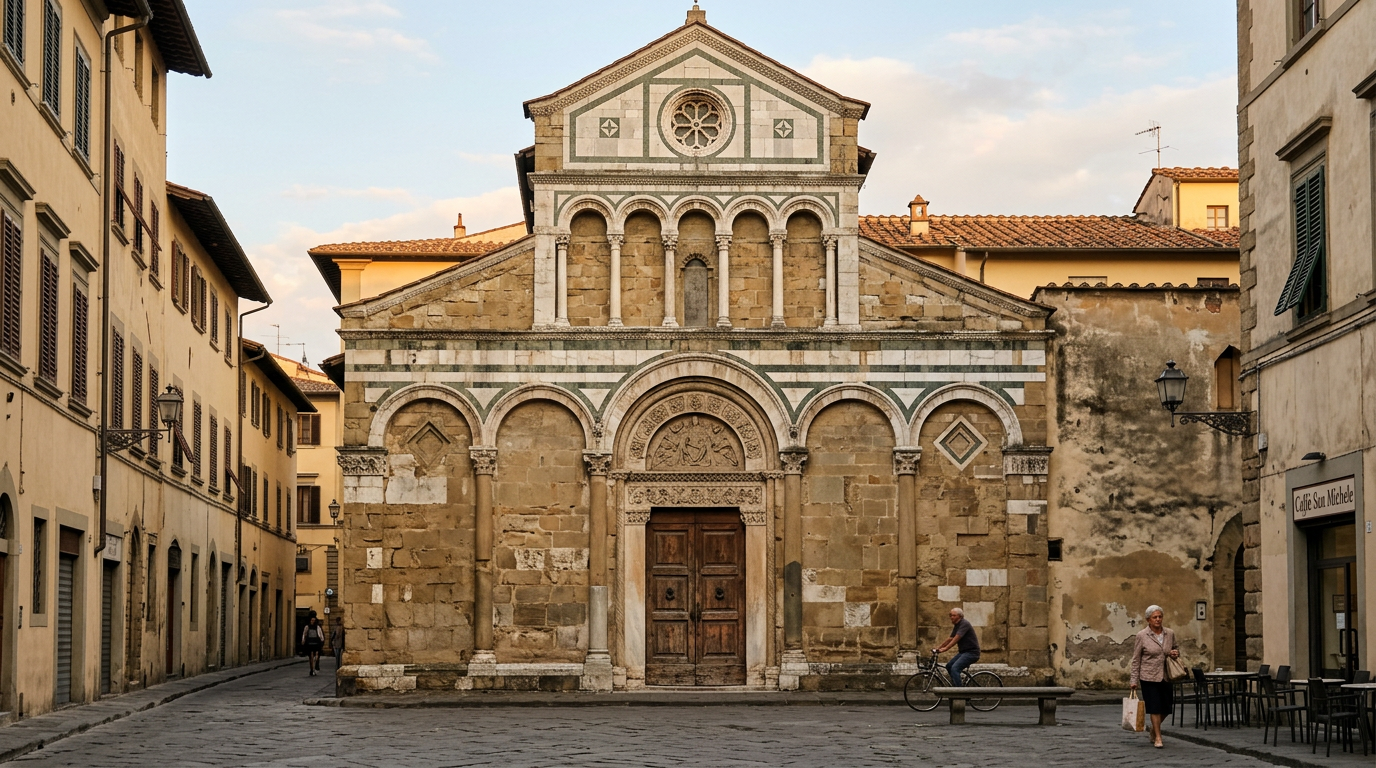
Construction began in 1018 on a hilltop site where a small oratory had previously stood, on land that had been associated with the cult of the martyred Saint Miniatus since at least the early medieval period. The facade was applied in stages from the 11th through the 13th centuries. It is clad in alternating horizontal bands of white Carrara marble and dark green marble from Prato, a colour scheme also used at the Baptistery and later at Santa Croce, and which defines the visual identity of medieval Florentine religious architecture.
Inside, three elements deserve sustained attention. The nave floor, completed in 1207, is inlaid with marble panels in geometric and zoomorphic designs including stylised lions, doves, and the signs of the zodiac. It is in remarkable condition for its age and repays attention at floor level rather than only from above.
The apse mosaic, visible from the nave above the altar, was completed in 1297. It depicts Christ enthroned between the Virgin and Saint Miniatus on a gold ground, following the formal conventions of Byzantine mosaic art that had been filtering into central Italian practice since at least the 11th century. The quality of the tesserae and the integration of the mosaic with the architectural frame are exceptional.
The crypt, reached via staircases on either side of the nave, holds the remains of Saint Miniatus and dates from the 11th century. Its columns are spoliated from earlier Roman and early medieval structures: different materials, different heights, not originally designed together. This ad-hoc character gives the crypt a density and texture that complements the deliberate formal beauty of the nave above.
Entry is free. The church is open daily from 09:30 to 13:00 and 15:00 to 19:00 in summer, with slightly shortened winter hours. Gregorian chant vespers take place at 17:30 on weekdays and 17:00 on Sundays, sung by the Olivetan monks who have occupied the adjacent monastery since 1373.
Planning a day around the minor churches
Visiting these churches requires some advance planning, because most have significant midday closures and limited opening hours that differ from the major museums.
A practical one-day circuit runs as follows. From 09:00 to 12:30: start at Santa Felicita in Oltrarno (opens 09:30). Allow 30 to 40 minutes for the Capponi Chapel. Cross the Arno back to the north bank and walk to Orsanmichele on Via dei Calzaiuoli (opens 10:00). Allow 30 to 45 minutes. End the morning with a visit to the Brancacci Chapel in Santa Maria del Carmine, also in Oltrarno, which requires advance booking and costs 10 euros. Allow 45 minutes.
After a midday break, take bus 13 from near the Uffizi to Piazzale Michelangelo, then walk the additional 10 minutes uphill to San Miniato. Arrive at 15:00 or 15:30 to allow an hour inside before vespers. Attend vespers at 17:30 if the timing works. Descend on foot through the hillside gardens back to the Arno, a walk of about 20 minutes.
Total walking distance for this circuit is roughly 6 kilometres. Total entry costs are minimal: about 2 euros for the Capponi Chapel, 10 euros for Brancacci, everything else free.
Where to Stay in Florence
The Key is located at Via Cittadella 22, five minutes on foot from Santa Maria Novella station in Florence. Santa Felicita is about 20 minutes on foot from the guesthouse, crossing the Arno at Ponte Vecchio or Ponte Santa Trinita. Orsanmichele is approximately 15 minutes on foot heading southeast through the centre along Via dei Calzaiuoli. Full details at The Key.