Florence on 1 November: Making the Most of All Saints Day
A clear guide to Florence 1 November what to do: which museums are open, the cemetery visits, the best uncrowded galleries, and day trips for the long weekend.
1 November is Tutti Santi, All Saints Day, a national public holiday in Italy. It falls alongside 2 November, the Day of the Dead, which is not itself a public holiday but is observed culturally. Together they create a long weekend that draws a moderate flow of Italian domestic visitors to Florence, adding some activity to what is otherwise one of the calmest months of the tourist calendar.
Understanding what is actually open, what is worth doing, and how to use the surrounding days well makes the difference between a visit that feels limited and one that takes full advantage of the season.
The Character of the November 1st Weekend
The long weekend typically begins on Friday 31 October or Saturday 1 November and extends through Sunday 2 November. Many Italians take additional days to bridge the holiday to the nearest weekend.
There is no major civic ceremony or street parade for 1 November in Florence. It is not San Giovanni, Easter, or Liberation Day. What it is instead is a pause: a moment when the city’s rhythm shifts and the streets feel more spacious than at any other autumn point.
Late October and early November temperatures average 8-16 degrees. Rain is possible. Coat and hat weather in the morning, with slightly warmer midday conditions if the sun is out. The autumn light at this time of year is excellent: low, warm, and particularly good for seeing the colour that has developed on the hills south of the Arno.
A walk up to Piazzale Michelangelo or San Miniato al Monte on the afternoon of 1 November can be one of the most atmospheric things you experience in Florence. The hills are showing their best autumn colour, the air is clear after any October rain, and the viewpoint is largely uncrowded.
What Is Open on 1 November
Most major tourist sites operate on 1 November under their normal Sunday hours.
Uffizi (open 8:15-18:30, last entry 17:30): Open. Slightly busier than a typical autumn weekday due to the holiday weekend, but not at summer levels. Booking ahead is still recommended.
Galleria dell’Accademia (open 8:15-18:50): Open. Same situation as the Uffizi.
Bargello (open 8:15-13:50): Open in the morning only. Visit early and pair it with a nearby morning activity.
Palazzo Pitti, Galleria Palatina (open 8:15-18:30): Open on 1 November.
Boboli Gardens (open 8:15-17:30, last entry 16:30 in November): Open, though the shorter hours mean planning an early afternoon visit.
Cappelle Medicee (open 9:00-14:00): Open with reduced hours.
Most churches in Florence are open for services on 1 November, closing to general visitors during mass (typically at 9:00, 10:30, and 12:00). Visiting hours outside of services are posted on church doors.
Many small local shops and some neighbourhood restaurants close on 1 November. Tourist-facing restaurants in the centre generally stay open. Booking ahead for dinner is sensible.
The Cemeteries: An Unusual and Worthwhile Visit
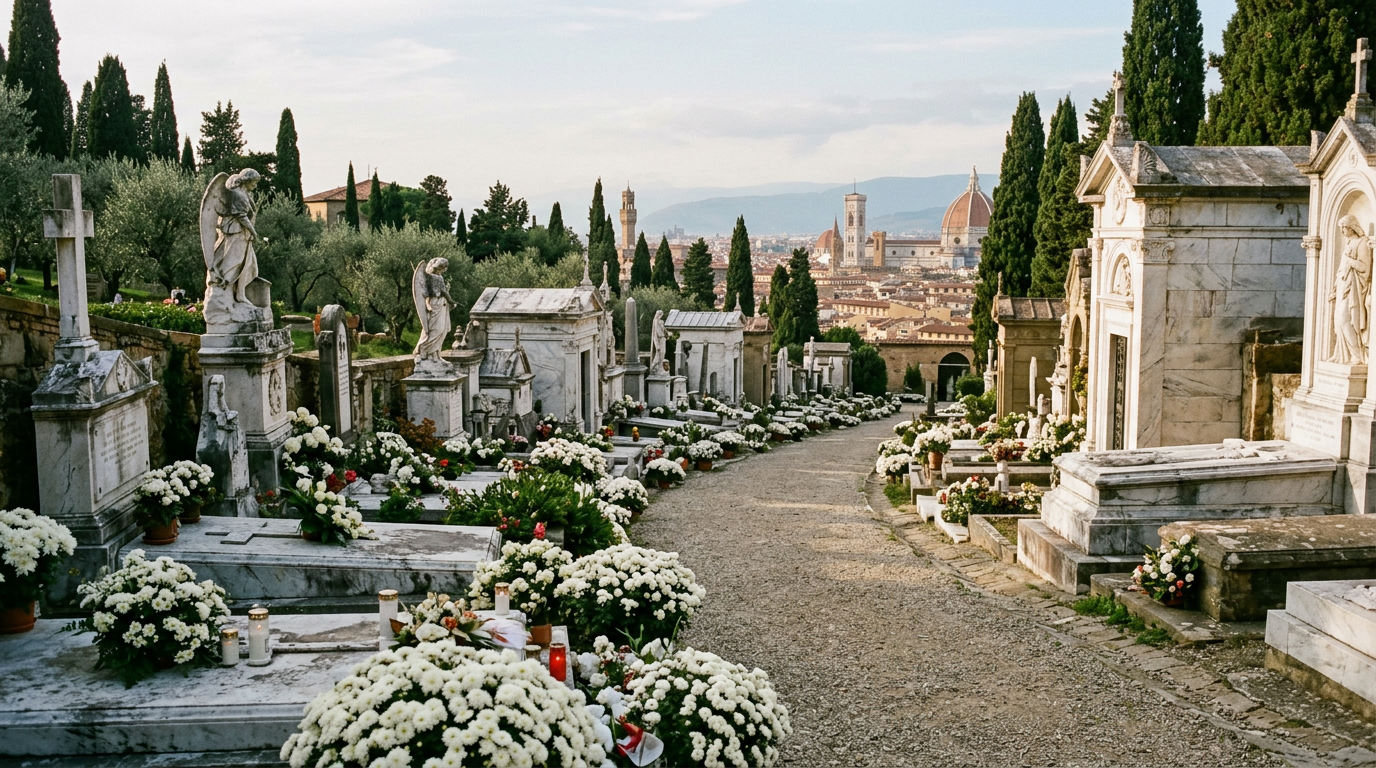
1 and 2 November are the traditional days for visiting cemeteries in Italy. Florentines bring flowers to the graves of relatives. The cemeteries are open, active, and treated as genuine public spaces during this period. A visit on 1 November is not morbid; it is a window into a living cultural tradition.
Cimitero delle Porte Sante (Via delle Porte Sante 28, next to San Miniato al Monte): This is Florence’s most architecturally significant cemetery. Designed in the 19th century against the old city walls and the hillside below San Miniato al Monte, it contains the graves of notable Florentines including architect Giuseppe Poggi, who designed Piazzale Michelangelo. Entry is free and the cemetery is open daily.
On 1 November, the paths are decorated with fresh flowers and the cemetery is notably atmospheric. The combination of the Romanesque church of San Miniato above, the old walls on one side, and the well-maintained Art Nouveau and neoclassical monuments within makes this one of the most unusual visits available in Florence at any time of year.
Cimitero degli Allori (Via Senese 184, approximately 5 km south of the Duomo): The historic Protestant and non-Catholic cemetery of Florence. It contains the graves of English and American residents from the 19th and early 20th centuries, including sculptor Lorenzo Bartolini. It is less visited than Porte Sante but worth the trip by car or bus (line 36 or 37 from the centre).
Galleries and Museums That Are Genuinely Uncrowded
November is one of the quietest months for Florence’s smaller museums. The Uffizi and Accademia see some increase around the holiday weekend, but the mid-sized and specialist institutions are calm throughout the month.
Museo di San Marco (Piazza San Marco 3, entry 4 euros, open Tuesday-Friday 8:15-13:50, Saturday-Sunday 8:15-16:50): The collection of Fra Angelico frescoes, one per monk’s cell in the 15th-century Dominican convent, is among the most extraordinary things in Florence. The museum is almost never crowded, even on public holidays.
Museo dell’Opificio delle Pietre Dure (Via degli Alfani 78, entry 4 euros, open Monday-Saturday 8:15-14:00): Florence’s specialist museum of stone inlay (commesso fiorentino). Small, meticulously arranged, and consistently quiet. It covers a craft tradition that is specific to Florence and genuinely difficult to understand without seeing the tools, techniques, and finished pieces together.
Museo Horne (Via dei Benci 6, entry 7 euros, open Monday-Saturday 9:00-13:00): A private Renaissance palace housing a collection assembled by English collector Herbert Horne, including works by Giotto, Filippino Lippi, and Beccafumi. Rarely visited by tourists and a genuine alternative to the main circuit.
Galleria Palatina at Palazzo Pitti (included in the Pitti entry, 16 euros): Raphael, Titian, and Rubens displayed floor to ceiling in a decorative scheme unchanged since the 17th century. The experience is fundamentally different from the Uffizi’s clean chronological hang, and the November quiet makes it easier to spend time with specific paintings.
Day Trips for the Long Weekend
The November 1st weekend is well-suited to day trips. The main Tuscan destinations are accessible by public transport and have significantly fewer visitors than any other holiday period.
Siena (90 km south, 90 minutes by bus from the Santa Maria Novella bus station via SENA/Flixbus, or approximately 1.5 hours by train with a change at Empoli): The Piazza del Campo and the Duomo complex are both open on 1 November. The Museo Civico (Piazza del Campo 1, entry 10 euros) and the Duomo (entry prices vary by combined ticket option) are worth including.
Arezzo (80 km southeast, approximately 45 minutes by direct train from Santa Maria Novella, 7-12 euros): The Basilica di San Francesco houses Piero della Francesca’s cycle of the Legend of the True Cross, one of the most significant fresco sequences in Italian art. Booking is required for entry; tickets available at pierodellafrancesca.it. Entry 12 euros. Arezzo itself is a pleasant mid-size city with a good historic centre and almost no international tourist crowds.
Volterra (80 km west, accessible by SITA bus from Florence, approximately 2 hours): The alabaster city on the ridge, with its Etruscan museum and medieval towers, is particularly good in autumn when the surrounding countryside is at its most colourful.
Where to Stay in Florence
The November 1st weekend sees a modest rise in accommodation demand in Florence relative to the surrounding weeks, but it remains manageable with reasonable advance planning. The Key is at Via Cittadella 22, a 5-minute walk from Santa Maria Novella station, which is also the departure point for SENA and Flixbus services to Siena and the main rail connection for Arezzo and Pisa. Full details at The Key.