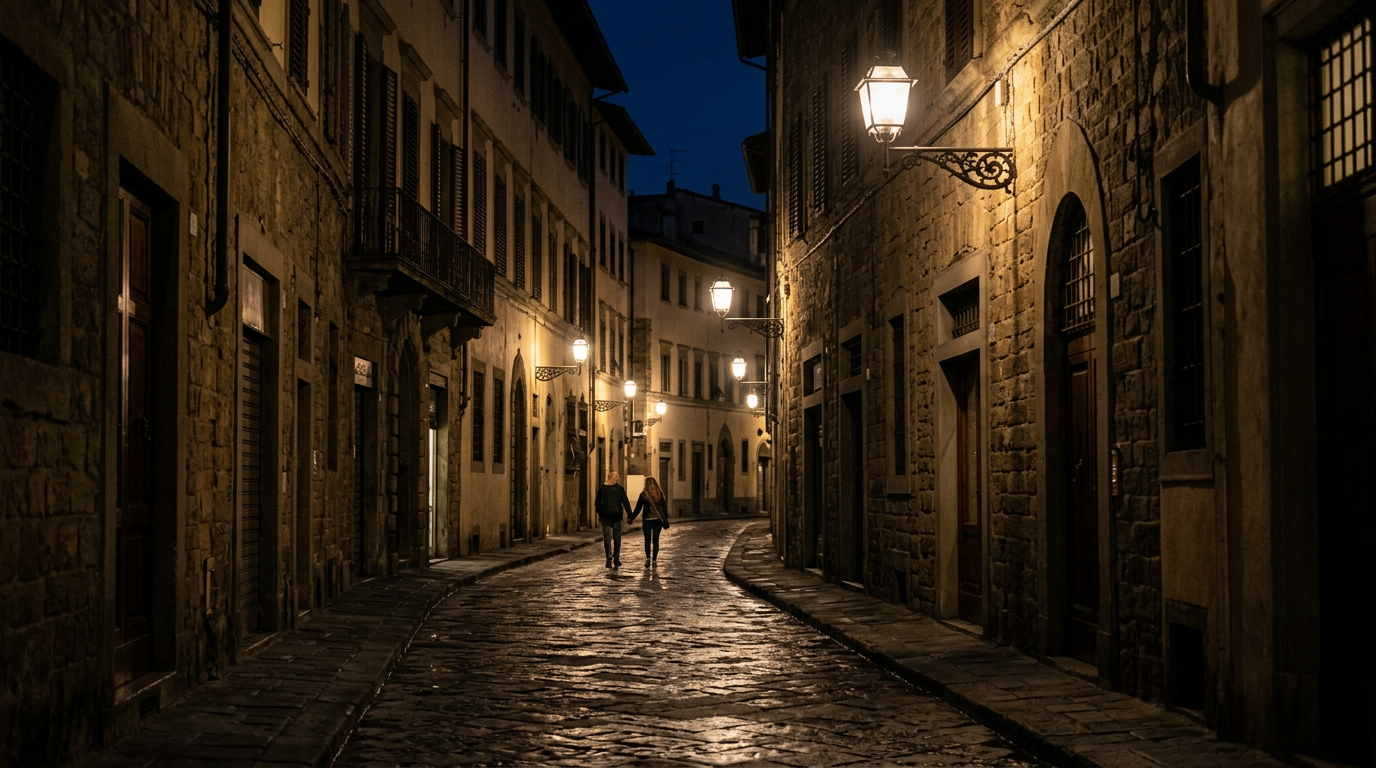
Walking Florence's Historic Streets After Sunset: Four Evening Routes
Discover the best Florence historic streets evening walks with routes along the illuminated Lungarno, through Oltrarno, and across the quiet alleys of the.
Why Florence belongs to the evening
Tourist Florence operates on a daytime schedule. By 09:00 the main piazzas are filling. By 11:00 the major museums are at capacity. By 13:00 the outdoor queues at the Duomo stretch back across the square. This is the rhythm of the city from spring through autumn.
After 18:30, that rhythm changes. Museum doors close. Tour groups board their coaches. The streets empty of the organised and fill with the aimless, which is to say, with the people who actually want to be there. Restaurants begin their dinner service. Bars in Oltrarno put out their outdoor chairs. The light drops from overhead to horizontal, and suddenly the Renaissance stone facades look like they were designed specifically for this quality of illumination. (They were, in a sense: most of them face west or south, and the builders knew what late afternoon light did to pietra serena.)
This is the Florence that rewards a slow evening walk. The following four routes cover the most atmospheric ground, with notes on where to stop along the way.
The illuminated Lungarno at night
The Arno at night is a reliable spectacle. The medieval towers on the south bank, the arches of the bridges, and the long reflections in the water combine into something that photographs poorly and looks better in person. This is useful to know before you arrive: do not rely on other people’s pictures. Go yourself.
The best evening walk along the river starts at Piazza Ferrucci near Ponte San Niccolo on the south bank and runs westward past Ponte alle Grazie, past the Ponte Vecchio, past Ponte Santa Trinita, and along to the Ponte alla Carraia or, if you want more ground, to the Ponte Amerigo Vespucci. The south bank stretch covers approximately 2.5 km. The north bank return, from Ponte alla Carraia back east to the Uffizi gardens, adds another 2 km.
The Ponte Vecchio between 20:00 and 21:00 is a notably different experience from midday. In summer the bridge still has visitors, but the pace is unhurried and the light from the shop fronts and lamp posts creates a warm, amber quality that the midday sun obliterates. In winter the bridge is sometimes nearly empty by 20:30.
The north bank between the Ponte Vecchio and Piazza dei Giudici has a cluster of wine bars with outdoor seating that faces the river. Prices here are slightly above average, as they always are at good views, but sitting with a glass of Vernaccia or local red while watching the water is a reasonable expenditure.
Via dei Servi and the alleys near the Duomo
Via dei Servi runs north from Piazza del Duomo to Piazza Santissima Annunziata in a nearly straight line. In the evening, around 19:00 to 20:30, this street is among the most atmospheric in the city. It is narrow enough to create a sense of enclosed space, lined on both sides by buildings from the 15th and 16th centuries, and quiet enough at this hour that you hear your own steps on the stone.
Walking north, the buildings flanking you light up from within. This contrast between the dark stone facades below and the warm domestic glow from windows two or three floors up is a specific quality of Florentine evenings that takes a moment to recognise and then becomes hard to stop noticing.
Piazza Santissima Annunziata at the northern end of Via dei Servi is worth arriving to in daylight first if possible, and then again in the evening. The loggia of the Ospedale degli Innocenti and the matching loggia of the church across the square form a symmetrical composition that was deliberately designed in the 15th and 16th centuries to produce this effect. In the evening, lit from below, the columns cast long shadows across the travertine floor and the mathematical precision of the whole thing is very clear.
From the Annunziata, the streets leading east toward Via degli Alfani pass through the university quarter. Bars and small restaurants are open and well-used on weekday evenings. Students, academics, and locals going about their evening create a genuine neighbourhood atmosphere.
Return south to the Duomo through Via dei Servi, or take a longer route via Borgo degli Albizi heading west. This street has a run of medieval tower-houses whose rooflines are best seen against a darkening sky.
Oltrarno: the city’s local evening neighbourhood
South of the Arno, the Oltrarno district functions differently from the historic centre to the north. In the evening, it fills not with tourists seeking monuments but with people seeking dinner and conversation. The streets feel lived-in rather than managed.
Cross the Ponte Vecchio and walk south along Via de’ Guicciardini to Piazza Pitti. The Palazzo Pitti facade at night, lit from below, has a weight that the pale stone loses in flat daytime light. The rusticated blocks of the lower story look almost geological in the evening illumination.
From Piazza Pitti, head west along Via Romana toward Via dei Serragli. This is the main street of the San Frediano sub-neighbourhood. The bars and restaurants here are oriented toward locals rather than tourists. Several establishments along Via dei Serragli set out tables on the pavement in warmer months and the street has an unhurried evening character.
Continue north on Via dei Serragli, then cut right toward Piazza del Carmine. The church of Santa Maria del Carmine, which contains the Brancacci Chapel frescoes by Masaccio, faces a quiet piazza ringed by bars and cafes. The outdoor seating here is used even in cool weather.
From Piazza del Carmine, follow Via Sant’Agostino east to Piazza Santo Spirito. This square is the social centre of Oltrarno in the evening. The bars operating around the piazza are busy most evenings from 19:00 to 23:00. The crowd skews local on weekday evenings, more mixed on weekends.
Where to stop: bars and wine by neighbourhood
Evening walks through Florence are naturally punctuated by brief stops. A few reliable options by location.
Lungarno, north bank near Piazza dei Giudici: Wine bars with outdoor tables facing the river. A glass of Chianti Classico costs 5 to 8 euros. The view justifies the location premium. Best from 19:30 to 21:30.
Via dei Servi area: Neighbourhood cafes behind Piazza Santissima Annunziata. More affordable than the Lungarno. Good for a coffee standing at the bar in the Italian manner, or a beer at a table. No tourist pricing.
Piazza Santo Spirito: Multiple bars with outdoor seating on the square itself. Drinks run 5 to 10 euros. Some bars serve small food plates until 22:00 or later. The crowd is local-heavy on weeknights and the energy is low-key but consistent.
Via San Miniato and Via dei Bardi in the San Niccolo neighbourhood: Wine bars and small enotecas that attract a genuinely local clientele, particularly from Thursday to Saturday. The medieval city walls nearby add a specific quality to the outdoor seating in summer.
One broader observation: Florentine bar culture in the evening is built around lingering. No one is rushing you away from a table. A second drink, a small plate of cheese or cured meat, a slow conversation: this is the expected pattern. It is the opposite of the tourist-timed experience that dominates the daytime city.
Where to Stay in Florence
The Key sits at Via Cittadella 22, 5 minutes on foot from Santa Maria Novella station in Florence. The Lungarno is a 15-minute walk south from the guesthouse. Piazza Santo Spirito and the Oltrarno is about 25 minutes on foot heading south and across the river.
Evening walks from this central position can cover significant ground and return home without doubling back on the same streets.
Full details at The Key.