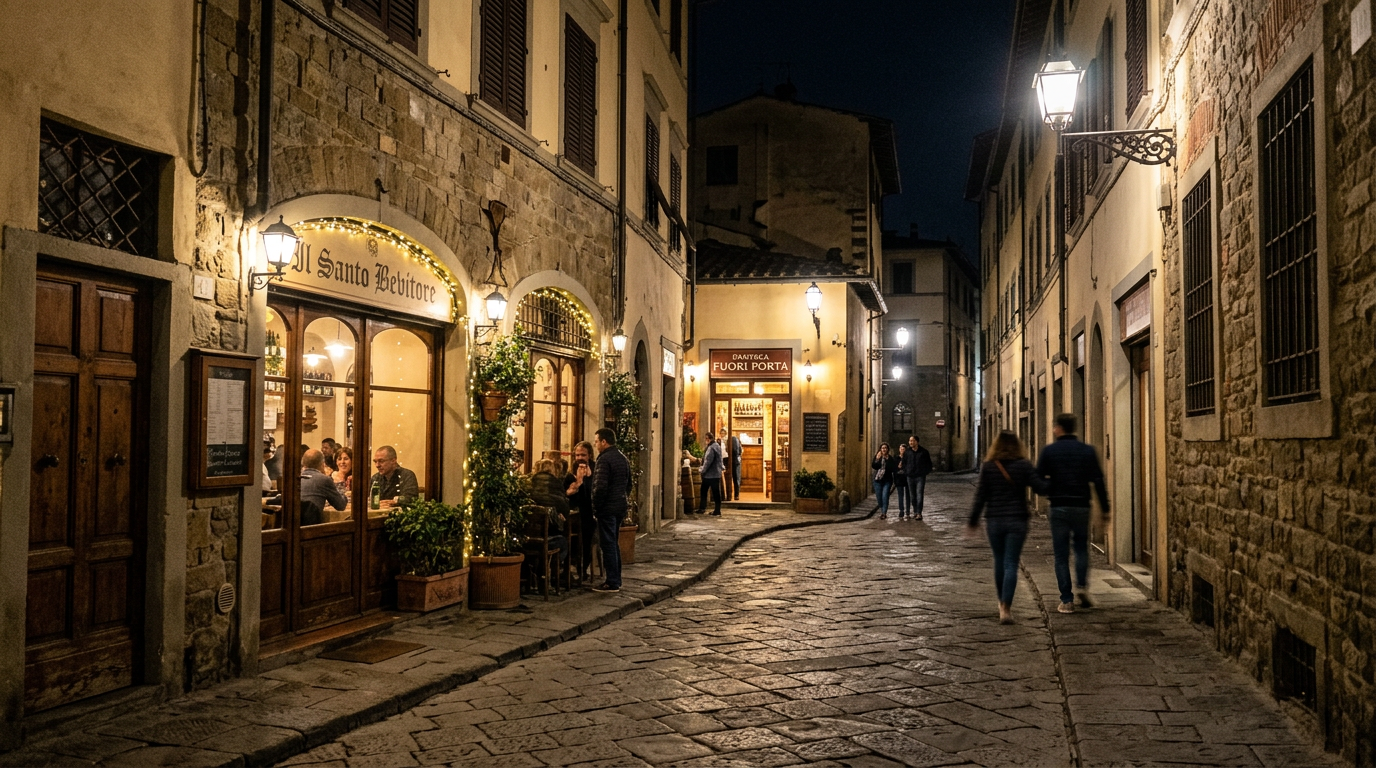
Florence San Niccolò Neighbourhood Guide: Bars, Workshops, and the Medieval Tower
Your complete Florence San Niccolò neighbourhood guide: when to visit, where to drink, which artisan workshops to seek out, and how to reach this Oltrarno gem.
The neighbourhood Florentines tend to keep to themselves
San Niccolò occupies a slender strip of land on the south bank of the Arno, pressed between the water and the hillside that climbs toward Piazzale Michelangelo. Named after the church of San Niccolò Oltrarno and the medieval tower that anchored the old city gate here, it is a neighbourhood that tends to come up whenever Florentines are asked which part of the city they consider most genuinely themselves.
The answer is not purely sentimental. San Niccolò still has the ingredients that have disappeared from much of the historic centre: working artisan workshops on operational streets, bars where the clientele is overwhelmingly local, and a physical scale that belongs to a pre-tourist city. The core area covers only about 500 metres in any direction, centred on Via San Miniato and Via di Belvedere, bounded by the Arno to the north and the old city walls to the south and east.
It is not a discovery. Anyone who asks will be told about it. But it has so far retained more of its character than the more frequently cited Oltrarno neighbourhoods to the west, which have been significantly altered by the concentration of tourism-facing businesses around Piazza Santo Spirito and Via dei Serragli.
The Torre di San Niccolò
The Torre di San Niccolò is one of the most substantially intact medieval towers surviving in Florence. Built in 1324 as part of the city’s third and final ring of defensive walls, it stands 37 metres tall and functioned as a fortified gate on the road running south from the city toward the hills.
Unlike the majority of the medieval wall circuit, which was dismantled in the 1860s when Florence underwent its urban modernisation phase, this tower and the adjacent section of wall along the riverbank were preserved. Partly this was due to aesthetic pressure: by the late 19th century, the combination of the tower, the city walls, and the hillside above had become a recognised feature of the city’s scenic identity, and there was enough organised opposition to demolition to prevent it.
The tower is open to visitors in summer, typically from June through September. The internal staircase leads to the top level, from which you get a close view of the hillside rising above the neighbourhood and a slightly different angle on the Arno valley. Entry costs approximately 4 euros. Hours vary and it is worth checking with the Florence municipality (comune.fi.it) before making the visit a priority.
The area around the base of the tower, along Via di Belvedere and the old wall, is worth visiting regardless of whether the tower itself is open. Early morning and late evening are the best times: the combination of medieval stone, cypress trees on the slope above, and near-silence creates an atmosphere that has changed very little in material terms over the past two centuries. A water wheel at the old mill site nearby, now operating as a restaurant, occasionally adds sound to the scene.
Drinking in San Niccolò
San Niccolò has developed over the past 20 years into one of the most consistently reliable areas in Florence for an evening drink. The bars here are, with few exceptions, genuinely local businesses that have been operating for a decade or more, with regular customers who know the staff by name and come several times a week.
The bars on Via San Miniato and the immediately adjoining streets operate as wine bars and cocktail bars in roughly equal measure. Many have been in the same locations for 10 to 20 years. They are not trying to appeal to passing tourist traffic; their economics depend on the neighbourhood. This affects the atmosphere in ways that are difficult to quantify but immediately apparent when you walk in.
One characteristic of drinking in San Niccolò that distinguishes it from the tourist-facing bar districts: in summer and through much of spring and autumn, the bars extend their territory informally onto the street and toward the base of the old city walls. Customers carry drinks outside and occupy the stone surfaces of the walls and the pavement. The boundary between the bar’s physical space and the public street dissolves in a way that would be unusual almost anywhere else in the centre. This is generally tolerated by the municipality and entirely consistent with the character of the neighbourhood.
Prices here are fair by any measure. A glass of house wine costs approximately 4 to 6 euros. A Negroni is 8 to 10 euros. Aperitivo snacks typically come with any drink order, without additional charge. These prices run 1 to 2 euros lower than equivalent drinks in the tourist-facing bars around Ponte Vecchio or Piazza della Signoria, a difference that reflects the absence of tourist pricing rather than any reduction in quality.
The neighbourhood is busiest on Thursday, Friday, and Saturday evenings from about 19:00 to 22:30. Tuesday and Wednesday evenings in summer are also well-frequented but with a slightly smaller and more intensely local crowd.
Artisan workshops
What makes San Niccolò distinct from other parts of the Oltrarno is the survival of a cluster of genuinely operational artisan workshops. These are not boutiques that use the word artisan as a marketing label. They are workshops where things are made and repaired, by craftspeople who trained through apprenticeship and have worked in the same spaces for decades.
The trades represented in the neighbourhood include furniture restoration, bookbinding, frame gilding, leatherwork, decorative painting, and fresco conservation. Several of these workshops serve both private clients and major museums. Some of the conservators working on Via San Miniato have contributed to restoration work at significant Florentine institutions.
If a workshop has its door open, it is generally acceptable to stop briefly and observe from the threshold. Some craftspeople are happy to explain their work to visitors who show genuine interest. Others prefer not to be interrupted. Read the situation rather than assuming either welcome or indifference. A brief, quiet observation and a respectful acknowledgment as you leave is the right approach.
Via dell’Olmo and the smaller lanes off Via San Miniato have the highest concentration of working workshops. Via dei Bardi, slightly north toward the Arno, also has several restoration businesses and a handful of artisan shops that sell directly to the public.
If you want to buy directly from a craftsperson in San Niccolò, the most effective approach is to look for open doors rather than window displays. Prices in these workshops are fair by craft standards: a hand-stitched leather wallet is typically 40 to 80 euros. A hand-bound journal runs 15 to 35 euros.
Getting there and timing your visit
San Niccolò is accessible from the historic centre north of the Arno via any of the bridges east of Ponte Vecchio. The Ponte alle Grazie is the most direct crossing if you are coming from the Uffizi or the Santa Croce area. From Ponte Vecchio itself, walking south along Costa dei Magnoli brings you into the neighbourhood in about 8 minutes.
From Santa Maria Novella station, the walk takes 25 to 30 minutes through the centre. Buses 23 and C3 run through the Oltrarno and have stops within a 5-minute walk of the neighbourhood.
For the artisan workshops, weekday mornings between 09:30 and 12:30 are best. Most workshops observe a midday closure and reopen from 15:00 to 19:00. Saturday mornings work well for most workshops; Sundays most are closed.
For the bars and evening atmosphere, Thursday to Saturday evenings from 19:00 are the most animated. If you prefer a quieter visit with the same neighbourhood character, Tuesday or Wednesday evenings provide that.
October is an especially good month to visit. As the tourist numbers reduce elsewhere in the city, San Niccolò returns more fully to its residents. The bars and workshops continue operating year-round regardless of season, but autumn brings a calm that makes the neighbourhood particularly easy to appreciate.
Where to Stay in Florence
The Key is at Via Cittadella 22, five minutes on foot from Santa Maria Novella station in Florence. San Niccolò is about 25 to 30 minutes on foot from the guesthouse, crossing the Arno at Ponte Vecchio or continuing east to the Ponte alle Grazie. The walk from the station through the historic centre and across the river to the neighbourhood passes through several distinct zones of the city and is worthwhile in its own right. Full details at The Key.