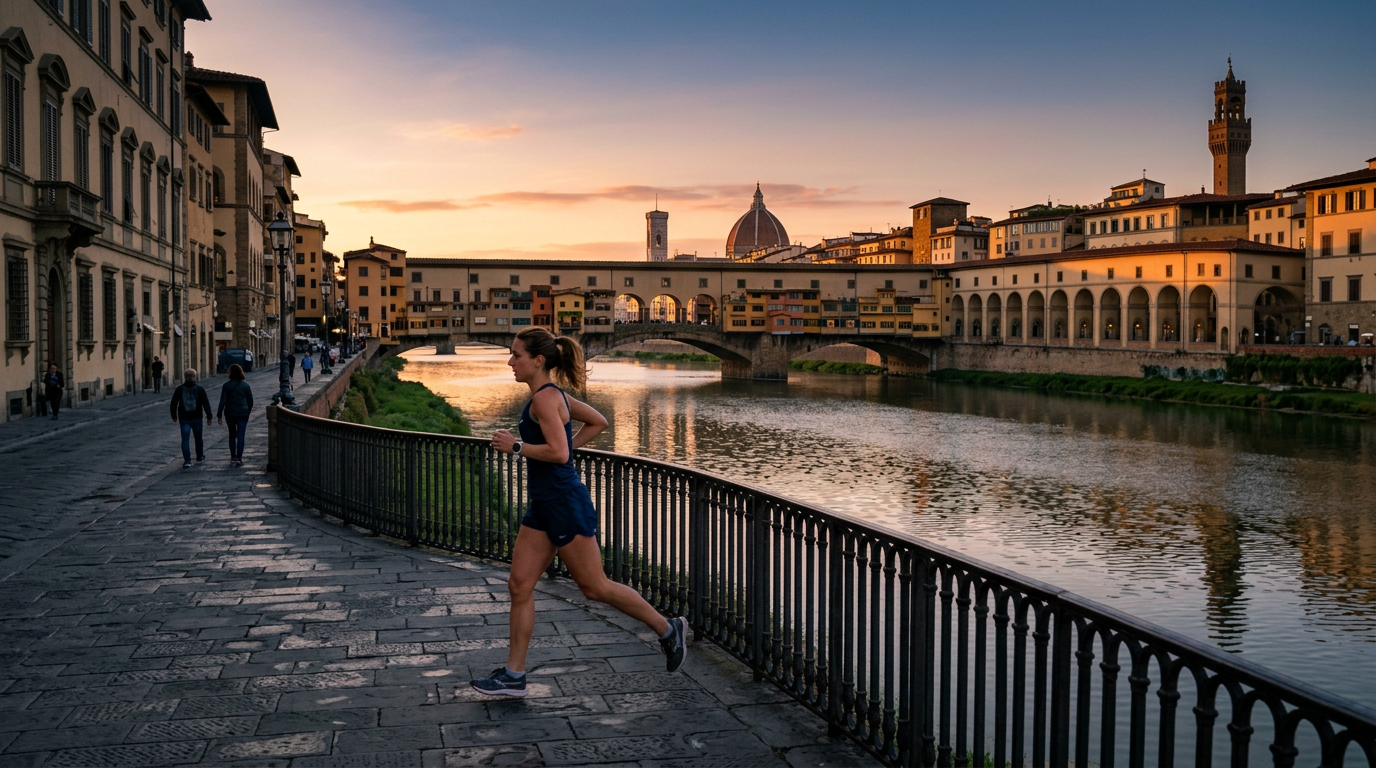
Running in Florence in the Morning: Practical Routes and Timing
A runner's guide to the best Florence running routes morning by morning, covering the Lungarno, the Cascine, the Fiesole climb, and when to go for the.
Running in Florence: the honest picture
Florence is not immediately obvious as a running city. The historic centre has narrow medieval streets, uneven cobblestones, and by 08:30 on any summer morning, enough tourist foot traffic to make a continuous stride nearly impossible. Add temperatures that regularly reach 34 degrees in July and August, and the case for lacing up starts to feel weak.
Spend a bit more time looking, and the city reveals a different side. The Arno riverside path, the Cascine park, and the hill road to Fiesole each offer running terrain that stands up on its own merits. The trick is knowing which route suits which morning and when to leave the door.
This guide gives you four running environments with specific distances, surface notes, and the optimal time window for each. Whether you have 30 minutes before breakfast or 90 minutes for a proper long run, there is a route here that works.
The Lungarno route along the Arno
The Lungarno is the network of roads and paths running along both banks of the Arno. For runners, the most useful section is the south bank stretch between Ponte alle Grazie and Ponte San Niccolo, roughly following Lungarno Torrigiani and Lungarno Benvenuto Cellini.
This path runs flat along the river edge, has a paved or compacted surface throughout most of its length, and in the early morning carries almost no vehicle traffic. A simple out-and-back from Ponte alle Grazie to Ponte San Niccolo is about 2.5 km each way, making a 5 km total. Extend westward along the north bank from Ponte Santa Trinita toward Ponte della Vittoria and the loop grows to roughly 9 km.
A few notes on the surface. Near the Ponte Vecchio area, the path narrows and shares space with cyclists and early delivery vehicles. Keep right and be alert. A few cobblestone sections near Piazza dei Mozzi call for shorter, careful strides.
The Lungarno is well lit after dark, making it a viable evening run as well. Some runners use it after 21:00 in summer when the day’s heat has finally dropped to something manageable. The Ponte Vecchio area stays busy with evening walkers, so expect to weave.
The best morning window for the Lungarno: 06:00 to 08:00 in summer. After 08:30, riverside road traffic increases and the footpaths near the bridges start to fill.
The Cascine park for longer sessions
The Parco delle Cascine is Florence’s largest public park, stretching as a long narrow strip of land between the Arno and the Mugnone rivers about 3 km west of the centre. It is roughly 2 km in length and between 150 and 400 metres wide, with a perimeter of approximately 5 km.
Internal paths cross the park in several directions. An outer perimeter road is partially closed to vehicles. Both the road and the internal paths have either packed gravel or paved surfaces and next to no elevation change. The result is the most forgiving running terrain within easy reach of the city centre.
The park has a recognisable running community. On weekday mornings from around 06:30, you will find local groups training on the perimeter road and occasional solo runners on the internal paths. It feels like a place that belongs to runners, which it effectively does before 09:00.
Distance options are flexible. A single perimeter loop is approximately 5 km. A common longer route starts from the Santa Maria Novella area, runs west along the Lungarno to the park’s eastern gate, completes one or two internal loops, and returns. Depending on the internal route chosen, this comes to between 10 and 14 km.
To reach the Cascine from the city centre, run west along Viale Fratelli Rosselli or take the back streets to Piazza Vittorio Veneto and enter the park at the eastern gate. From the Santa Maria Novella neighbourhood, the eastern gate is roughly 1.5 km on foot.
The Fiesole hill run for the serious climb
Fiesole sits at about 295 metres above sea level. Florence’s city centre is at around 50 metres. The climb from Piazza della Libertà at the northern edge of the city to the Piazza Mino in Fiesole covers approximately 7 km with 250 metres of net elevation gain. This is a proper hill run, not a gentle incline.
The recommended ascent follows Via Giovanni Boccaccio and then branches onto Via Vecchia Fiesolana. The latter is a narrower road through residential gardens and olive groves. Vehicle traffic is light on weekday mornings. The surface is paved throughout.
A realistic time for the ascent is 45 to 65 minutes depending on your fitness level. The gradient is consistent rather than brutal, which means a steady pace is possible throughout.
What you earn beyond the physical effort: the view from Fiesole is spectacular. Looking back south, the Arno valley opens wide, with Florence’s terracotta roofline clear in the foreground and the Chianti hills extending to the south on clear days. It is the kind of view that justifies the effort even when your legs are arguing otherwise.
The bar on Fiesole’s main piazza opens at 07:00. Arriving after a morning climb for a coffee and a cornetto before descending is one of those small pleasures that makes a running holiday feel worthwhile.
On the descent, run carefully. The road bends are tight and you build speed faster than expected. Shorter strides on the steeper sections protect the knees.
Timing your run: a practical breakdown
Heat and foot traffic are the two things that constrain running in Florence. Here is a realistic breakdown of each time window.
Before 07:00 is the best option in summer. Temperatures at 06:00 in July and August sit around 18 to 22 degrees Celsius. The streets are almost silent, and the Lungarno and Cascine are yours. The tradeoff is an early alarm, but the experience is worth it.
07:00 to 08:30 works well for the Cascine and the outer Lungarno. In the historic centre, delivery vehicles appear from 07:30 onward. Avoid Via dei Calzaiuoli, the Duomo area, and Via Por Santa Maria from 08:00 if you are running that direction.
08:30 to 10:00 is still usable in September and October. In July and August, temperatures by this point make sustained running in the city uncomfortable. The south bank Lungarno stays cooler slightly longer due to building shade.
11:00 to 16:00 should be avoided entirely in summer. Air temperatures regularly reach 33 to 38 degrees Celsius and the reflected heat from Florence’s stone streets adds several degrees on top of that.
After 19:30 is the evening alternative. Once the sun drops below the surrounding hills, temperature falls noticeably and the city takes on a different quality. The Lungarno is pleasant for evening runs. The Cascine remains safe and well-used until dark.
One practical note: carry water for any run over 5 km. Formal running fountains are rare on these routes, but Florence has small stone drinking spouts called fontanelle built into walls across the city. They are free, reliably cold, and scattered along most of these routes if you know to look for them.
Where to Stay in Florence
The Key is at Via Cittadella 22, 5 minutes on foot from Santa Maria Novella station. The eastern gate of the Cascine park is 1.5 km from the guesthouse, making it a comfortable warm-up run before the park loop begins. The Lungarno is about 15 minutes south on foot through the historic centre, and the Fiesole trailhead is reachable by bus from the station before you run.
Full details at The Key.