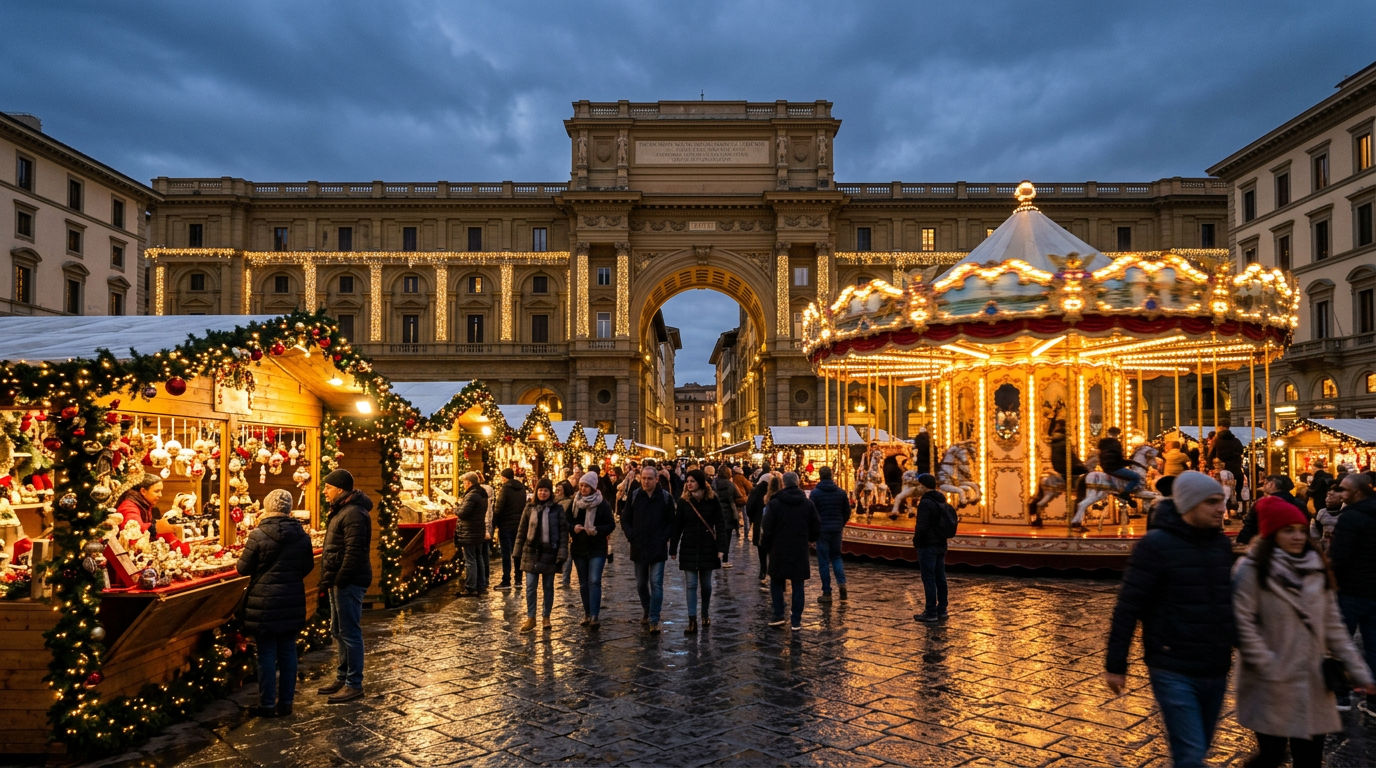
Florence Christmas Markets: A Visitor's Guide to the Festive Season
Everything you need to plan around Florence Christmas markets what to do: locations, light installations, nativity scenes, holiday dining and January sales.
Florence at Christmas has its own particular quality. It is not the overtly spectacular Christmas of some northern European cities. What it offers instead is the combination of remarkable architecture, cold clear winter air, and lights that have been placed carefully rather than deployed in quantity. Visitors who come specifically at this time often prefer it to any other season.
The Christmas period officially runs from 8 December (Feast of the Immaculate Conception) through 6 January (Epiphany). The most active weeks are the three leading up to Christmas Day and the stretch between 26 December and 1 January.
The Atmosphere in December
December temperatures in Florence average 4-12 degrees. Evenings are cold enough for a proper coat and scarf. This is the season for warm drinks at market stalls, fire-lit restaurants, and walking through streets that are less densely packed with tourists than at any summer point.
The Christmas period partially reverses the winter low season. The Uffizi and Accademia are noticeably busier in the week between Christmas and New Year than at almost any other winter moment. If your trip falls in that window, book museum tickets before you arrive.
Outside that Christmas-to-New-Year stretch, December remains one of the calmer months for museums and restaurants. If you visit in early December, you can walk into many smaller institutions without a queue at all.
Via dei Tornabuoni, the city’s main luxury shopping street, carries its Christmas light installation from early December. Piazza della Repubblica has increasingly elaborate illuminations in recent years, including projections on the surrounding facades.
The Christmas Markets
Weihnachtsmarkt in Piazza Santa Croce is the main event. The market runs from late November to 24 December, typically 10:00-21:00 on weekdays and until 22:00 on weekends. Entry costs 1-2 euros.
This is a genuine German-style Christmas market with around 80 stalls. It has been running for over 25 years and has an established identity. The stalls cover handmade crafts, seasonal food, and mulled wine. The setting against the facade of the Basilica di Santa Croce, lit up at night, is one of the more striking urban Christmas scenes in Italy.
Mercatino di Natale at Piazza della Santissima Annunziata is smaller and more focused on Italian artisan work rather than German imports. It runs on weekends in December and is worth including if you are in the city on a Saturday or Sunday in December.
Fierucola di Natale: Usually held on one Sunday in mid-December near Piazza della Repubblica or Orsanmichele, this is an extension of the regular monthly Fierucola market. It focuses on organic and locally produced food and gifts. Entry is free.
Mercato Centrale (Via dell’Ariento, first floor open daily until 24:00): Not a Christmas market strictly, but reliably open and warm through December. The first floor runs special food events and tastings throughout the month, making it a good refuge on cold December afternoons.
The Lights and Nativity Displays
The Via dei Tornabuoni installation is the most photographed. The street runs from Piazza Antinori to Piazza Santa Trinita and is pedestrianised in the evenings. A walk through it in the week before Christmas, when the temperature drops and the light is at its most dramatic, is worth scheduling deliberately.
Florence has a strong nativity scene tradition (presepi). The most elaborate examples appear in churches from 8 December. Santa Croce, the Duomo, and the church of Ognissanti (Piazza Ognissanti 42, free entry) all typically display nativity scenes. Many are artistic rather than purely devotional, with significant craft invested in the figures and settings.
The Presepe Vivente (living nativity) is sometimes performed in the Oltrarno in December, usually in Piazza Santo Spirito or the courtyard of a historic building. Check the Comune di Firenze events calendar for the specific date and location in the current year.
What to Do During the Holiday Week
The period from 26 December through 1 January is the busiest stretch of the winter. Italian visitors from other regions arrive in significant numbers alongside international travellers. Restaurant queues are longer, accommodation prices reach their annual peak for the winter season, and the most popular cafes fill quickly.
The Uffizi runs extended holiday hours across this period. The Duomo complex closes on 25 December and 1 January, with additional closures for specific religious services; check the official website for exact hours.
The Basilica di Santa Croce (Piazza Santa Croce 16, open 9:30-17:30, entry 8 euros) is particularly relevant at Christmas. It contains the tombs of Michelangelo, Galileo, Machiavelli, and Rossini. The nativity display and the Cimabue Crucifix in the adjacent museum are highlights.
San Miniato al Monte on Christmas Day: if you are in Florence on 25 December, the climb to San Miniato is worth making. The Benedictine monks sing Gregorian vespers in the late afternoon. The church is one of the finest examples of Romanesque architecture in Italy, and the winter view from the hilltop over the city is clear and memorable.
The days between 27 December and 6 January often bring genuine sales (saldi anticipati) at shops on Via dei Tornabuoni and Via della Vigna Nuova. These are real reductions from pre-Christmas prices, not seasonal adjustments.
Eating Over Christmas
Finding a restaurant open on 25 December requires advance work. Many local trattorias close for the holiday. Hotel restaurants typically serve Christmas lunch and dinner at fixed menus starting from 60-80 euros per person.
Some central restaurants run Christmas Day menus with advance booking required. Key areas to search: the Oltrarno, Via de’ Benci, and around Piazza della Repubblica. Book weeks in advance for Christmas Day specifically.
For 26 December (Santo Stefano, a national public holiday in Italy), the situation improves considerably. Most restaurants reopen and the city is animated with Italian day visitors from nearby towns.
New Year’s Eve (cenone di Capodanno): most mid-range to upscale restaurants run a fixed multi-course menu from around 20:00 through midnight, typically priced at 60-150 euros per person depending on the venue. Booking two to three weeks ahead is standard; popular venues fill up well before Christmas.
Where to Stay in Florence
December and early January require forward planning for accommodation, particularly for the Christmas and New Year window when demand is high and options narrow. The Key is at Via Cittadella 22, a 5-minute walk from Santa Maria Novella station, and is well placed for walking to all the Christmas market locations, the Via dei Tornabuoni lights, and the piazza celebrations described in this guide. Full details at The Key.