Florence Antique Market on Sunday: A Complete Visitor's Guide
The Florence antique market Sunday scene explained: Piazza dei Ciompi, Piazza Santo Spirito, what to buy, realistic prices, and how to negotiate without.
Florence and its antique market tradition
Antique dealing in Florence has deep roots. The city spent centuries accumulating objects of historical and artistic significance, and the trade in those objects, whether through auction houses, specialist dealers, or open markets, has been part of the city’s commercial fabric since the Renaissance. Objects of genuine historical interest, furniture from the 18th and 19th centuries, prints and maps, ceramics, glassware, silver, and everyday objects from earlier eras, surface at Florence’s markets with reasonable regularity.
The Sunday antique market scene in Florence is organised around two primary locations. One runs on a specific Sunday each month and is focused on flea market and second-hand goods that expand into proper antiques. The other is a monthly curated market in Oltrarno, with a somewhat more focused selection. Beyond these, specialist antique dealers in Oltrarno and the streets around Piazza Santa Croce operate from permanent shops that are worth exploring separately.
The Piazza dei Ciompi Market: every last Sunday
The Piazza dei Ciompi is the centre of everyday antique and second-hand trading in Florence. From Monday to Saturday, a permanent set of established stalls occupies the south side of the piazza, selling printed material, old photographs, vintage postcards, ceramics, small furniture pieces, and general curiosities.
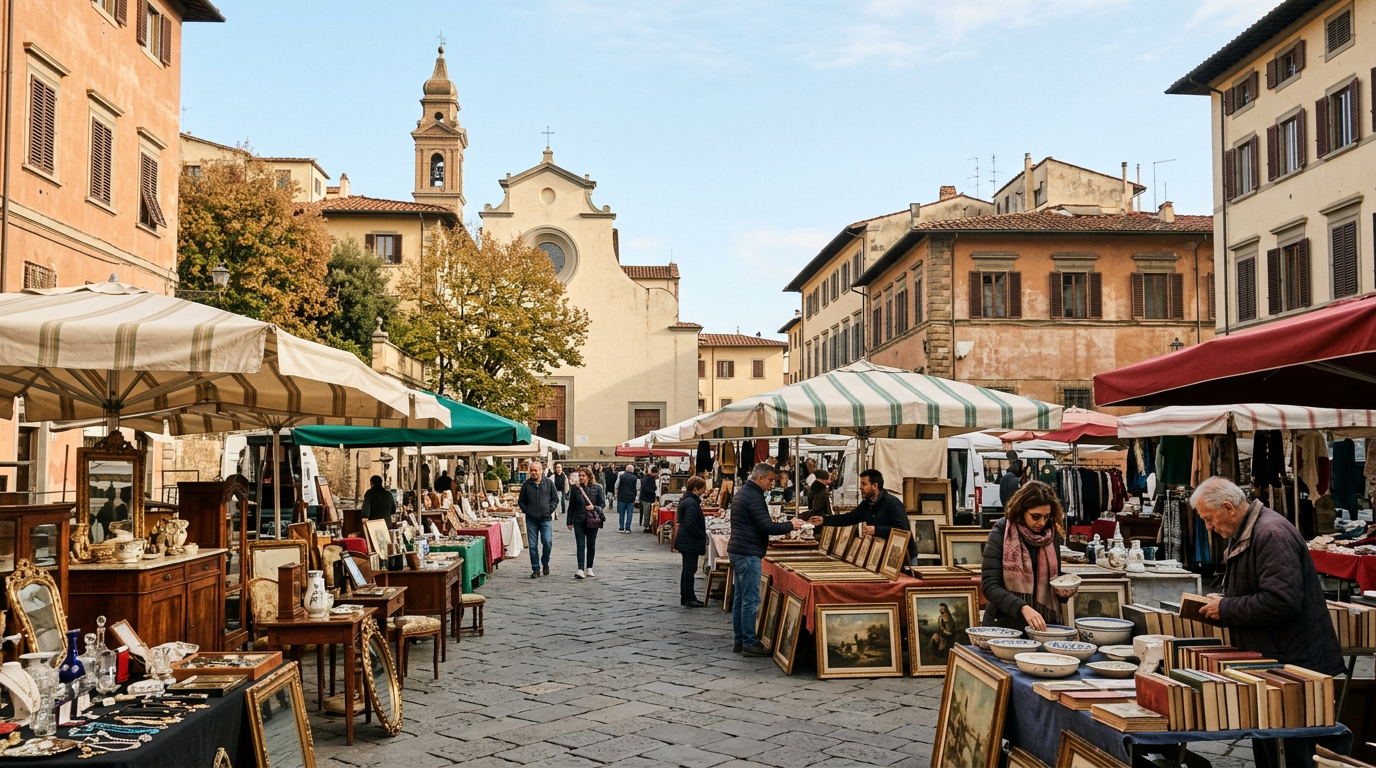
On the last Sunday of each month, the market transforms. Additional dealers arrive with temporary stalls that fill the entire piazza and spill into the surrounding streets. This expanded format is the single best opportunity in the city to browse genuine antiques and quality second-hand goods in one location.
The range of goods at the expanded Ciompi market is genuinely broad. Vintage clothing from the 1950s through the 1980s. Vinyl records priced from 3 to 10 euros per disc. Old books and illustrated volumes, particularly Italian-language editions from before 1950. Prints and lithographs from the 19th and early 20th centuries. Antique silverware, often hallmarked. Florentine faience and hand-painted majolica. Old tools, hardware, and mechanical objects. Military memorabilia and uniform items. Twentieth-century furniture and lighting. And a general category of objects that resist tidy classification.
The piazza is on Via Pietrapiana in the Sant’Ambrogio neighbourhood. From Santa Maria Novella station: take bus 14 toward Via Gioberti, or walk the full 25-minute route through the historic centre. Stalls begin setting up around 08:30 and the market is fully operational from approximately 09:00 to 09:30.
The Piazza Santo Spirito Monthly Market: every second Sunday
The Piazza Santo Spirito antique and artisan market runs on the second Sunday of each month. The market occupies the piazza in Oltrarno and covers antiques, vintage objects, and artisan crafts rather than general second-hand goods.
The character here is somewhat more curated than at Ciompi. The dealers tend to work within defined specialisms: antique furniture, vintage jewellery, ceramic and glass objects, engraved maps and prints, and objects made by hand using traditional methods. The overall standard of presentation is higher, which is reflected in slightly elevated prices.
An antique print that might be priced at 8 euros at Ciompi could be 15 euros at Santo Spirito, but the condition and provenance may be better. For buyers with a specific type of object in mind, the additional cost is often worth paying for the assurance that the object has been selected and presented by someone who knows the category.
To reach Piazza Santo Spirito from Santa Maria Novella station: walk south through the historic centre, cross the Arno at Ponte Vecchio, and continue through Oltrarno. The full walk takes about 25 minutes. Bus C3 runs from the centre into the Oltrarno.
The market opens at approximately 09:00 and runs until 19:00. It is cancelled in significant rain; check local listings or the Florence municipality website before making a dedicated trip.
What you find and what to expect to pay
A practical breakdown of categories and prices helps frame expectations before you arrive.
Prints and paper goods: black-and-white photographic prints from the early 20th century sell for 5 to 20 euros depending on subject and condition. Coloured lithographs from the 19th century: 15 to 60 euros. Antique maps of Florence or Tuscany: 20 to 120 euros depending on age and quality of printing. Old postcards: 0.50 to 3 euros each.
Books: Italian-language books published before 1940 are common and cost 2 to 8 euros per volume. Illustrated volumes with original engraving plates run 15 to 50 euros. Books in English appear, especially at Ciompi, but are less frequent.
Ceramics and glass: hand-painted majolica and terracotta pieces range from 10 to 80 euros depending on age, condition, and decoration quality. Murano glass objects from the 20th century: 15 to 100 euros per piece. Ordinary 19th-century glassware: 3 to 15 euros.
Furniture: small 19th-century pieces such as chairs, occasional tables, and mirror frames sell for 80 to 300 euros. Objects attributed to the Renaissance or baroque periods cost significantly more and should be examined carefully for authenticity and evidence of restoration.
Vintage clothing: 1970s and 1980s garments are the most common and cost 8 to 25 euros per piece. Well-preserved 1950s and 1960s items: 20 to 60 euros. Quality is strongly dependent on condition; Italian vintage clothing in excellent original condition commands a justified premium.
Silverware and jewellery: antique silver at Italian markets typically carries hallmarks. The Italian silver marks are 800 or 925, equivalent to sterling standards. Small pieces, spoons or sugar tongs, cost 10 to 30 euros. Brooches and earrings from the 1930s through the 1960s: 15 to 60 euros. Always verify hallmarks before buying silver.
How to negotiate without causing offence
Bargaining at Italian antique markets is normal and expected. It follows conventions that, if understood, make the process productive rather than awkward.
Open with genuine interest, not with a price. Dealers respond better to buyers who show real curiosity about an object. Ask where it came from, roughly how old it might be, what it was used for. This creates a basis for conversation and signals that you are a serious buyer rather than a visitor testing prices out of habit.
Make a proportionate offer. A standard opening is 20 to 30 percent below the asking price. Offering less than half the asking price is generally read as insulting and tends to end the negotiation immediately. If the asking price is 30 euros, an opening of 22 to 24 euros is reasonable. An offer of 10 euros is not.
Bring cash and have it ready. Almost all market stalls at Ciompi and Santo Spirito are cash-only. Some dealers have card readers, but connectivity at outdoor markets is unreliable. Arriving with 80 to 100 euros in small and medium denominations is practical preparation.
Arrive early. The best items at flea markets and antique fairs go in the first hour or two of the market day. For the Ciompi expanded Sunday, arriving at 09:00 rather than 11:00 makes a real difference in what you find. Prices also tend to be more flexible in the early morning, when dealers are motivated to start their day with a transaction.
Walk away when appropriate. If a dealer will not budge from a price that does not suit you, note the piece and continue browsing. Return later in the day. If it is still there, the dealer may be more willing to negotiate. If it is gone, you have useful information about the real demand for that type of object at that price.
Where to Stay in Florence
The Key is at Via Cittadella 22, five minutes on foot from Santa Maria Novella station in Florence. The Piazza dei Ciompi market is about 25 minutes on foot from the guesthouse through the historic centre. Piazza Santo Spirito, for the second-Sunday monthly market, is about 25 minutes in a different direction, south through the centre and across the Arno. Both markets are reachable on foot without needing to check bus schedules, which makes planning a Sunday morning around the market straightforward. Full details at The Key.