Florence Medici History Curiosities: The Details Most Guides Skip
Discover Florence Medici history curiosities beyond the guidebook surface: the real politics, the architectural legacy, the lesser-known sites, and the.
The Medici without the mythology
No family in European history has been more consistently romanticised than the Medici. They appear in popular culture as enlightened philosopher-kings who funded the Renaissance out of pure aesthetic vision. The reality is considerably more interesting than this picture.
The Medici were first wool traders, then money changers, then international bankers. They became de facto rulers of a republic that had no official position of ruler. They funded artists and philosophers not only because they appreciated culture but because they understood that beauty is a form of power: it projects wealth, sophistication, and permanence to everyone who sees it.
The family rose from the wool trade in the late 13th century. By the early 15th century, the Medici bank was the largest in Europe, with branches in 16 cities. Its most important client was the papacy, whose financial operations across Europe gave the Medici leverage over popes and access to economic intelligence that no competitor could match.
Understanding the Medici as strategic investors in cultural production, rather than as simple benefactors, produces a more accurate picture of how the Renaissance was actually funded, and why.
Places in Florence that most visitors miss
The major Medici sites are well known, but several deserve more attention than they typically receive.
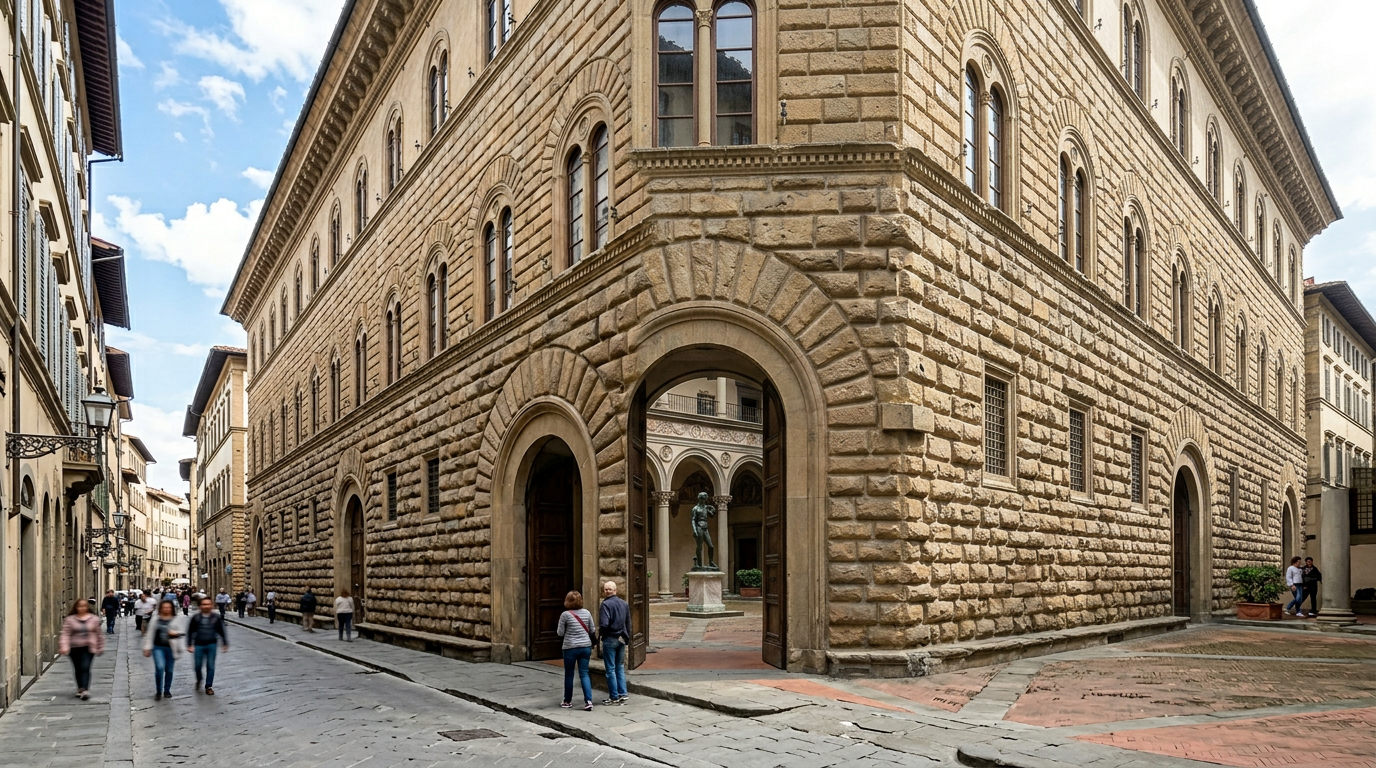
Palazzo Medici Riccardi at Via Cavour 3 is the right place to start any Medici itinerary. Michelozzo built it for Cosimo the Elder from 1444, and it served as the family’s main Florence residence for nearly 100 years. The architecture introduced the rusticated stone exterior that became the defining template for Florentine palace design. On the first floor, the Cappella dei Magi contains a fresco cycle by Benozzo Gozzoli (1459-1461) depicting the Procession of the Magi. The faces in the procession are portraits of the Medici family and their associates. It is one of the finest examples of early Renaissance secular portraiture and is frequently overlooked because the chapel is small and access requires a timed entry slot. Entry to the palace is 7 euros. Open Monday through Wednesday and Friday through Sunday 9:00-19:00, closed Thursday.
The Uffizi Gallery has a direct connection to the Medici that most visitors do not register. The building was constructed as the administrative offices (uffici) of the Medici state, designed by Giorgio Vasari in 1560 for Cosimo I. It was converted into a public museum in 1769 by the last Medici heir, Anna Maria Luisa. Her bequest stipulated that the entire Medici art collection must remain in Florence permanently, and could never be sold or moved abroad. Without this condition, the Uffizi’s holdings would have been dispersed across European royal collections over the following century.
San Lorenzo church and the Medici Chapels: the basilica of San Lorenzo was the Medici family’s parish church and eventual mausoleum. The Sacrestia Nuova, designed by Michelangelo between 1520 and 1534, contains the tombs of Lorenzo the Magnificent’s son and grandson. The four allegorical figures on these tombs, Day, Night, Dawn, and Dusk, are among the most analysed sculptures in art history. Entry to the Medici Chapels is 9 euros.
Cosimo the Elder and Lorenzo the Magnificent
These two men, separated by two generations, defined what is called the Medici golden period.
Cosimo de’ Medici (1389-1464), later given the title Pater Patriae by the Florentine state, built the foundation of Medici political dominance. He was exiled in 1433 by a rival faction that correctly identified him as a structural threat to the republic’s balance of power. He returned from exile in Venice in 1434, backed by allies he had cultivated across the city. He then spent the following three decades consolidating the family’s position without ever holding a fixed formal office.
He operated through financial patronage, carefully managed personal networks, and a public commitment to civic culture. He supported Donatello financially throughout his career. He funded Brunelleschi’s architectural projects. He established the Platonic Academy in Florence and invited Greek scholars who had fled Constantinople after 1453 to teach there. He was also the first Medici to be buried at San Lorenzo rather than in the family’s ancestral plot in the Mugello hills, a deliberate statement about the family’s permanent identity as Florentines.
Lorenzo de’ Medici (1449-1492), called Il Magnifico, is the Medici that most people imagine when they hear the family name. He was a genuine poet and a linguist who wrote in the Tuscan vernacular. His court at Palazzo Medici housed Botticelli, Leonardo da Vinci (briefly), Poliziano, Pico della Mirandola, and other major figures of the late 15th-century intellectual world. He established a sculpture garden near San Marco where young Florentine artists could study pieces from the Medici collection. Michelangelo was one of the young men sent there.
But Lorenzo also presided over the beginning of the family’s financial decline. The Medici bank contracted significantly during his period of dominance, partly through mismanagement and partly through political pressures from competing European powers. When he died in 1492, the business was already weakening.
How the dynasty ended
The Medici were expelled from Florence twice after Lorenzo’s death: in 1494 and again in 1527. Both times they returned within a few years, supported by external military force.
The third return, in 1530, was different. The family came back not as private citizens exercising influence behind the scenes but as hereditary rulers of a formal principality. Cosimo I (1519-1574) transformed Florence from a nominal republic into an organised state. He expanded Tuscan territory, commissioned the Uffizi as the administrative centre of his government, extended the Palazzo Vecchio, and built the Corridoio Vasariano linking the government palace to Palazzo Pitti.
The grand-ducal dynasty lasted until 1737, when Gian Gastone de’ Medici died without legitimate heirs. His sister Anna Maria Luisa negotiated the terms of transition before her own death in 1743. The Patto di Famiglia she signed with the incoming Lorraine dynasty preserved the entire Medici art collection in Florence permanently. Every work that today fills the Uffizi, the Bargello, the Accademia, and the Museo di San Marco exists in Florence because of that single legal document.
Details you will not hear on most guided tours
The Medici bank did not charge interest in the conventional sense. Charging interest on loans was classified as usury and forbidden by the Church. Instead, the bank generated equivalent revenue through currency exchange transactions structured to produce a profit that was legally interest but not called that. The papacy, as the bank’s primary client, understood the arrangement perfectly and accepted it.
In 1478, the Pazzi family, the Medici’s principal rivals in Florence, attempted to assassinate both Lorenzo and his brother Giuliano during High Mass in the Duomo. Giuliano was stabbed 19 times and died. Lorenzo escaped through the sacristy. His response to the conspirators was brutal: dozens were executed, the Pazzi family was stripped of property and expelled, and Botticelli was commissioned to paint portraits of the hanged conspirators on the facade of the Bargello. Public display of executed enemies was a recognised political communication.
Cosimo I, despite his considerable administrative effectiveness, was also capable of ruthlessness toward his own family. Historical accounts report that he had his son Garcia executed after Garcia allegedly killed another of his brothers in a dispute. Some modern historians question the accuracy of this account, but the story circulated widely in the 16th century and reflects the pressure under which later Medici family members operated.
The rural Medici villas, at Poggio a Caiano, Artimino, and in the Mugello valley north of Florence, served multiple functions. They were agricultural estates producing income. They served as political retreat venues for sensitive meetings. During plague outbreaks in Florence, which recurred regularly throughout the 15th and 16th centuries, they functioned as quarantine residences. Several are open to visitors today and attract a fraction of the visitor numbers of the city centre sites.
Where to stay for a Medici-focused visit
The Key is at Via Cittadella 22, five minutes from Santa Maria Novella station. Palazzo Medici Riccardi is about 15 minutes on foot through the centre. The Medici Chapels at San Lorenzo are approximately 12 minutes away by foot.
Full details at The Key.