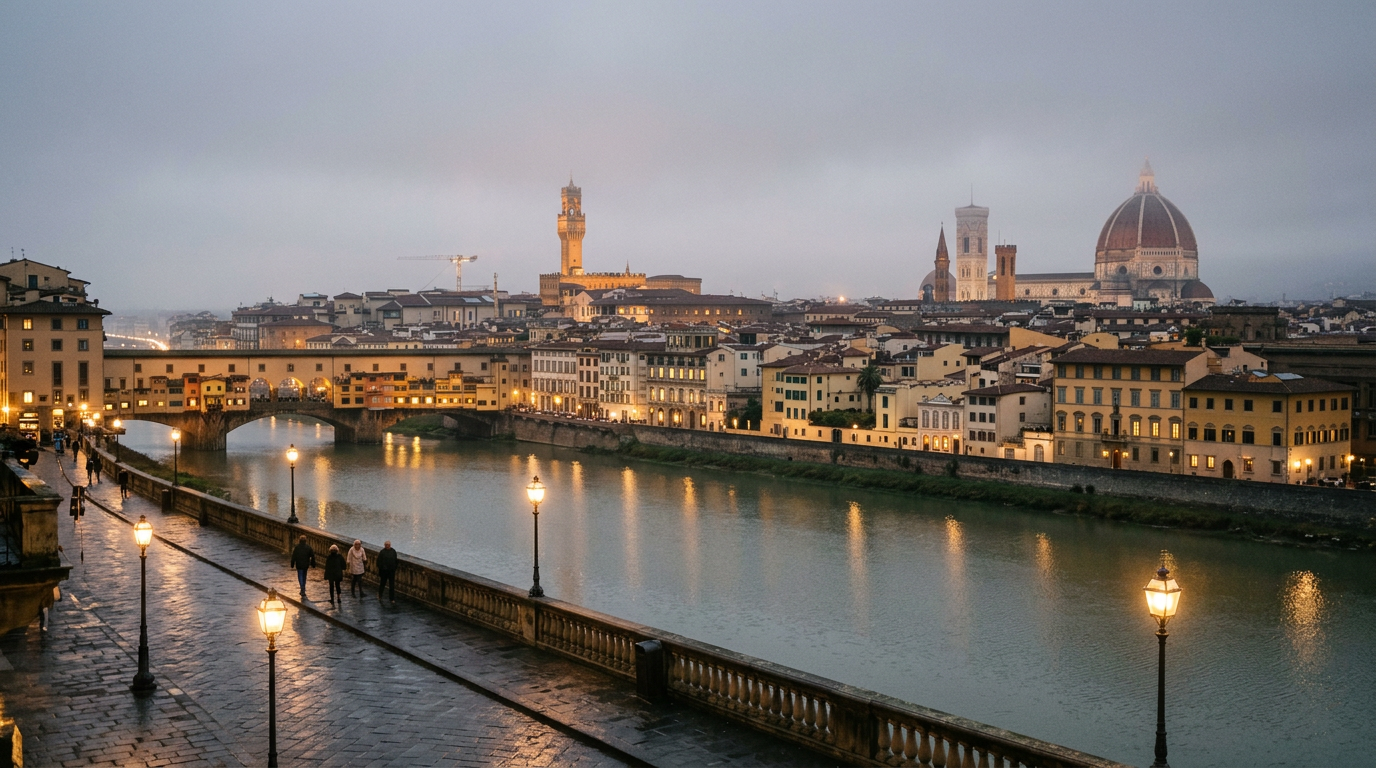
Florence in Winter: A Practical Guide to What Makes It Worth the Cold
Everything to do in Florence in winter, from queue-free museums and Christmas markets to rainy-day options and honest advice on how cold it actually gets.
The case for Florence in winter
Every travel guide to Florence recommends spring and autumn. They are right to do so, but that advice sends most visitors to the same short windows and creates the crowds those guides are trying to help you avoid. The people reading the same recommendations end up at the Uffizi on the same April Tuesday.
Winter makes a different case. From November through February, with the exception of the Christmas-New Year spike, Florence is a quieter, cheaper, and in some respects more honest city. The version of Florence you find in January is not performing for visitors. It is simply itself.
The practical advantages are real and measurable. Museum access, accommodation pricing, and restaurant availability all shift significantly in winter. Whether the cold is a deal-breaker depends on how you travel, but it is worth understanding what you actually gain before deciding.
Museum access: the single strongest reason
In January and February, walking into the Uffizi without a forward booking produces a wait of 10 to 20 minutes. In July, the same approach produces a 90-minute queue in outdoor heat. The contrast is significant enough to determine the quality of the whole experience.
The Uffizi (Piazzale degli Uffizi 6, open Tuesday to Sunday 08:15 to 18:30) still requires booking during the Christmas and New Year window, roughly 20 December to 6 January. Outside those dates, winter access is genuinely walk-in viable on most days.
The Galleria dell’Accademia (Via Ricasoli 60, open Tuesday to Sunday 08:15 to 18:50) holds Michelangelo’s David in a purpose-built hall designed to display it from every angle. In January, arriving at opening time, you can stand in front of the statue for several minutes without another person in your eyeline. In August, the same room has a continuous crowd from opening to closing.
The Palazzo Pitti complex (Piazza de’ Pitti 1) is worth noting. The Boboli Gardens have reduced winter hours, closing at 16:30 with last entry at 15:30. The Galleria Palatina inside the palace keeps its regular hours and is worth the 16-euro entry fee in any season.
The Museo di San Marco (Piazza San Marco 3, entry 4 euros) and the Cappelle Medicee in San Lorenzo (entry 9 euros) are both excellent winter choices. Small, focused collections, almost always uncrowded, in buildings that are as interesting architecturally as their contents.
The Museo dell’Opera del Duomo (Piazza del Duomo 9, open daily 09:00 to 19:00) deserves particular mention. It holds Ghiberti’s original Gates of Paradise bronze panels in a circular room designed specifically for them, as well as Michelangelo’s Pieta Bandini and Donatello’s wooden Mary Magdalene. Entry is included in the 30-euro Duomo complex pass. In winter, this museum is one of the most rewarding two hours you can spend in the city.
November: the quietest full month
November sits outside the two obvious quiet spells of deep winter and early autumn, which makes it easy to overlook. The summer events have finished. The Christmas season has not started. The weather is cool and sometimes rainy. Average temperatures run from 6 to 15 degrees.
What you get in exchange: the city at its most local. Florence in November is not arranging itself for an audience. The Mercato Centrale, the Oltrarno bars, and the streets around the university district are all running at a pace set by residents rather than tourism. This quality is hard to quantify but immediately apparent.
November is also when Florence’s food markets are at their most active in terms of seasonal produce. White truffles from the San Miniato area arrive in October and November. Porcini mushrooms appear in dishes across the city. The ribollita and pappa al pomodoro that define Florentine winter cooking are best in this season.
December: Christmas lights and the Weihnachtsmarkt
December shifts the atmosphere from quiet to festive from around the 8th of the month. Via dei Tornabuoni and Via della Vigna Nuova are strung with lights from the 8 December holiday. The streets feel genuinely illuminated rather than just commercially decorated.
The most notable December event is the Weihnachtsmarkt at Piazza Santa Croce. Florence has hosted this German-style Christmas market for decades. It is one of the oldest in Italy and has a genuine atmosphere rather than the improvised quality of newer Italian Christmas markets. The stalls sell food, craft items, and regional products. It runs from late November to 24 December.
The period between Christmas and 6 January sees a significant increase in visitors. Museums need advance booking during this window. Accommodation prices rise substantially. If your only option is a late December visit, book everything at least three to four weeks ahead and expect the city to be busy in a way the rest of winter is not.
How cold is Florence in winter: the honest answer
Florence is not dramatically cold by central European standards, but it is colder than many visitors expect. The Arno valley traps cold air. Humidity makes the temperature feel lower than the thermometer reads. January and February average 2 to 10 degrees Celsius, with frost possible on some mornings.
Snow is rare in the city centre. It falls on average once every two to three years, more frequently on the surrounding hills. When snow does arrive, the city is exceptionally beautiful but transport disrupts.
The practical implication for packing: layers work better than a single heavy coat. A waterproof outer layer is useful in November, December, and February when rain is most frequent. Good walking shoes remain essential year-round on Florence’s stone streets.
What the cold does not affect: museums, restaurants, and cafes operate normally throughout winter. There is no meaningful loss of indoor services or opening hours for the main attractions.
What to do on rainy days
Rainy days in winter Florence are not a problem. They are simply days spent indoors.
The Uffizi alone can fill a full day if you approach it properly rather than rushing. The permanent collection covers more than 45 rooms across multiple floors. In winter with space around you, it is possible to actually engage with individual paintings rather than moving quickly to avoid bottlenecks.
The covered Mercato Centrale food hall (Via dell’Ariento, open daily until midnight) is a reliable option for a rainy lunchtime. Around 20 stalls serve Florentine and Italian regional food at moderate prices in a comfortable space.
The Biblioteca Nazionale Centrale (Piazza dei Cavalleggeri 1) is the national library of Italy. Non-Italian readers have limited browsing material, but the building dates to the 18th century and the reading rooms are worth seeing if you are curious about Florentine institutional architecture.
Several covered shopping streets, particularly Via dei Calzaiuoli and the Mercato Nuovo (Piazza del Mercato Nuovo, covered loggia), provide dry routes between sites in rainy weather without needing a museum.
Where to Stay in Florence
In winter, proximity to the main sites matters more than in summer, when longer days and better weather make extended walking feel effortless. The Key is at Via Cittadella 22, 5 minutes on foot from Santa Maria Novella station, placing the Duomo, the major museums, and the covered city centre all within a short walk in whatever the weather brings.
Full details at The Key.