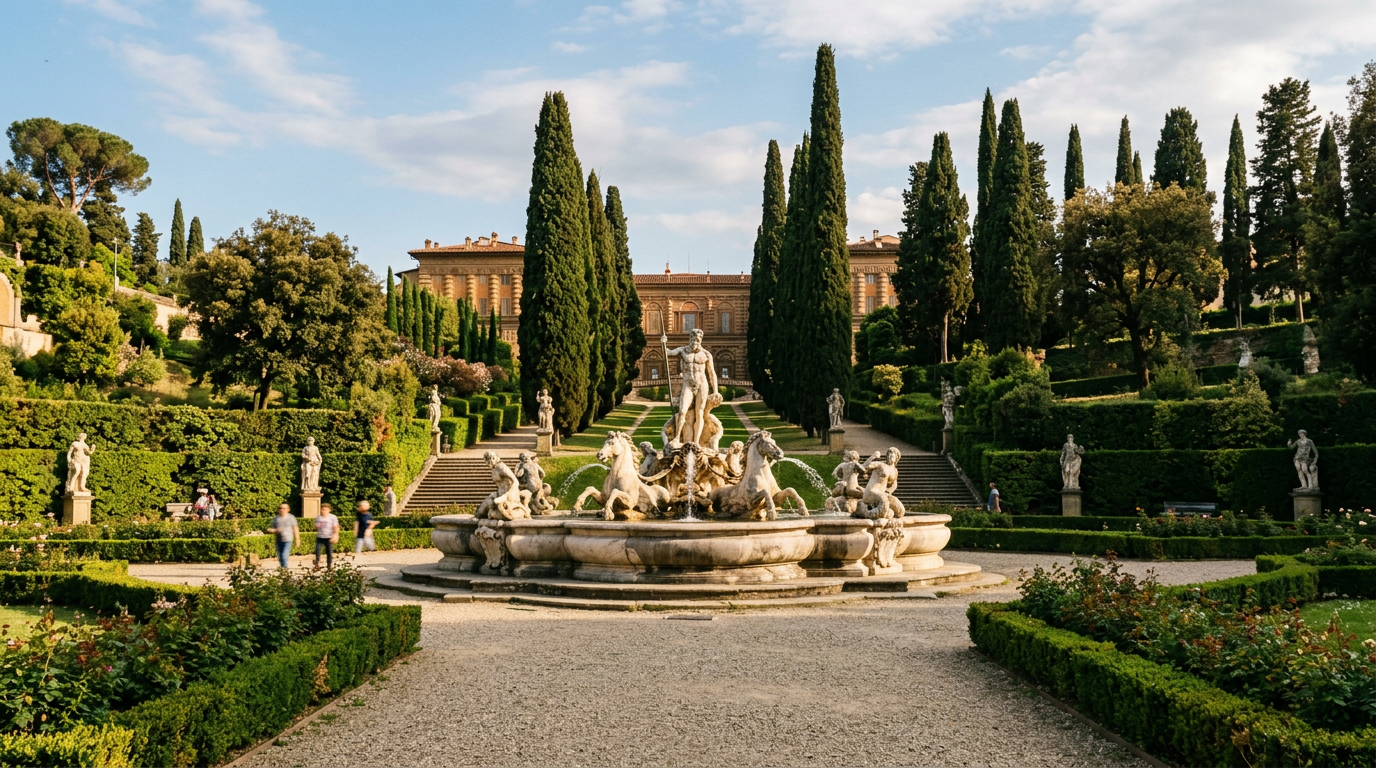
Florence Historic Gardens Visit: Boboli, Bardini, and the Rose Garden
Everything to know before your Florence historic gardens visit: Boboli, Bardini, Giardino delle Rose, Corsini, practical hours, entry prices, and best seasons.
Green spaces in a stone city
Florence does not market itself as a green city. The historic centre is dense with stone, terracotta, and mortar. Narrow streets channel you between facades rather than toward open space. The palette of the city, warm amber, grey pietra serena, rust-coloured roof tiles, is beautiful but enclosed.
This impression is incomplete. Florence contains several major historic gardens that are among the finest surviving designed landscapes in Italy. They are not pocket parks or decorative additions to the urban fabric. They are ambitious historical projects, laid out by the same architects and patrons who shaped the buildings around them, revised and extended over centuries, and now preserved as significant cultural heritage sites.
Visiting them also provides something no museum or piazza can: a view back over the city from the heights of the Oltrarno hillside, with Florence spread out below in a panorama that explains its geography better than any map.
This guide covers four gardens with practical information on entry, hours, and the best reasons to visit each.
Boboli Garden: the essential visit
The Boboli Garden covers approximately 45 hectares on the hillside rising directly behind Palazzo Pitti. It is the largest and most historically significant historic garden in Florence and one of the most important surviving Renaissance gardens in Italy. Work began in 1550 for Eleonora of Toledo, wife of Cosimo I de’ Medici, and continued under successive Grand Dukes through the 17th and 18th centuries. The result is a garden with multiple layers of design: formal Italian Renaissance geometry in the areas closest to the palace and a looser, more naturalistic approach in the upper sections added during the 18th and early 19th centuries.
The main entrance is from Piazza Pitti. Opening hours run 08:15 to sunset, with the specific closing time varying by season: 18:30 in September, 17:30 in October and November. The garden closes on the first and last Monday of each month. Entry costs 10 euros for adults. A combined ticket covering all three museums within the Palazzo Pitti complex costs 22 euros.
Three specific areas reward attention. The amphitheatre immediately behind the palace contains a 22-metre Egyptian obelisk from Luxor, quarried during the reign of Ramesses II and moved to Italy in the late 17th century. The Isolotto is a circular pool at the garden’s lower centre, with a central island occupied by an elaborate fountain and bordered by orange trees in terracotta pots. The Kaffehaus pavilion on the upper hillside has a terrace that offers one of the better close-range views over the city from within a garden setting.
Visiting strategy: the garden is most crowded in the lower sections near the palace entrance. The crowd thins substantially as you climb toward the upper garden. In summer, arriving when the garden opens at 08:15 allows you to walk the upper sections in relative solitude and in the cooler part of the day before the heat builds.
Giardino Bardini: less visited, more rewarding
The Bardini Garden sits immediately east of the Boboli on the same Oltrarno hillside. It is accessed separately, either from Via dei Bardi in the lower Oltrarno or from Costa San Giorgio above. It covers approximately 4 hectares across a steep slope and receives significantly fewer visitors than the Boboli, despite being in several respects more visually concentrated and more dramatically sited.
The garden’s central feature is a long pergola staircase that runs straight up the hillside on the central axis. The pergola is covered in wisteria. In the last week of April and the first two weeks of May, when the wisteria blooms in full, the effect is extraordinary: a tunnel of cascading purple-white flowers framing the city view below. This is one of the most visited garden moments in Florence during its brief season and is worth planning a trip around. At other times of year, the pergola structure remains impressive and the view from the upper terrace is available year-round.
The terrace at the top of the garden looks north over the rooftops of Oltrarno and the historic centre beyond. The perspective here differs from Piazzale Michelangelo: you are closer to the city and positioned slightly lower on the hillside, which changes the way the Duomo and the surrounding buildings relate to each other in the composition.
Entry costs 10 euros, or is included in a combined ticket with the Boboli Garden. Hours: 08:15 to sunset, closed Mondays. The Villa Bardini at the bottom of the garden contains a small permanent museum dedicated to Roberto Capucci, the Florentine fashion and fabric designer, and hosts a rotating exhibition programme. The cafe on the villa terrace has a good view and moderate prices given the setting.
Giardino delle Rose: timing is everything
The Giardino delle Rose occupies a terraced hillside between the road to Piazzale Michelangelo and the basilica of San Miniato al Monte. It is owned and maintained by the municipality of Florence, covers approximately 1 hectare, and offers views northwest over the city from its upper terraces.
The garden contains approximately 350 varieties of roses. They bloom from late April through June, with the peak typically in the second and third weeks of May. During this period the garden is heavily visited, sometimes uncomfortably so by mid-morning. An early start, before 09:30, provides both better photographs and a more pleasant experience.
Outside the rose season, the garden remains open and free, but the visual draw disappears largely until the following spring. The terraced structure, the views, and a collection of bronze sculptures by the Belgian artist Jean-Michel Folon placed throughout the garden remain as reasons to visit, but they are not the primary reason most people come.
Opening hours shift by season. From April to June, the garden is open daily from 09:00 to 20:00. From July to September, hours are Monday to Friday 09:00 to 20:00, with weekends closed. These hours can change; check with the Florence municipality website before visiting. Entry is free in all seasons.
Corsini Garden and the Orto Botanico
The Palazzo Corsini sul Prato on Lungarno Corsini has a private garden that is not open as a regular public attraction. Access is possible on selected dates, primarily during the FAI (Fondo per l’Ambiente Italiano) open-house weekends in spring and autumn. These weekends take place twice a year, typically in March and October, and the full list of accessible properties is published on fondoambiente.it in advance.
The garden is unusual in the context of the city. Most significant private gardens in the Florentine tradition are attached to villas in the surrounding countryside. A historic garden of this scale, with formal parterres, a lemon garden, and a section of mature woodland, located within walking distance of the river and the historic centre, is genuinely rare. The design dates to the 17th and 18th centuries and has been maintained with considerable fidelity to its historic character.
A reliable alternative for year-round access to a historic green space: the Orto Botanico at Via Pier Antonio Micheli 3, adjacent to Palazzo Medici Riccardi in the north of the historic centre. One of the oldest botanical gardens in Europe, founded in 1545 under Cosimo I de’ Medici for the study of medicinal plants, it covers about 2.3 hectares. Entry costs 4 euros. Open Monday to Friday from 10:00 to 18:00, closed weekends. Less visited than any of the hillside gardens, it offers a quiet hour in an unexpectedly tranquil setting within the city.
Where to Stay in Florence
The Key is at Via Cittadella 22, five minutes on foot from Santa Maria Novella station in Florence. The Boboli Garden entrance at Palazzo Pitti is about 25 minutes on foot from the guesthouse, crossing the Arno at Ponte Vecchio or Ponte Santa Trinita. The Bardini Garden and the Giardino delle Rose require an additional 10 to 15 minutes of walking from the Pitti area into the hillside above Oltrarno. Full details at The Key.