The Best Places to Photograph Florence: Light, Timing, and Hidden Viewpoints
A photographer's guide to the best places to photograph Florence, with specific timing advice, lesser-known viewpoints, and tips for working with the.
Photography in Florence: the real challenge
Florence offers a concentration of photographic subjects that few European cities can match in such a small area. The skyline, the river, the medieval streets, the Renaissance facades, the hills south of the Arno, the interiors of churches and galleries: each of these environments provides strong material across different conditions and times of day.
But the city is also one of the most photographed in the world. The familiar images, the panorama from Piazzale Michelangelo, the view along the Arno to Ponte Vecchio, the interior of the Duomo, have been taken millions of times and are immediately recognisable. Getting something genuinely your own requires knowing when to arrive, which direction the light comes from, and where to go when the famous viewpoints are crowded.
This guide covers the most rewarding locations with the specific practical information that makes a good photograph possible.
Piazzale Michelangelo: the classic panorama and when to use it
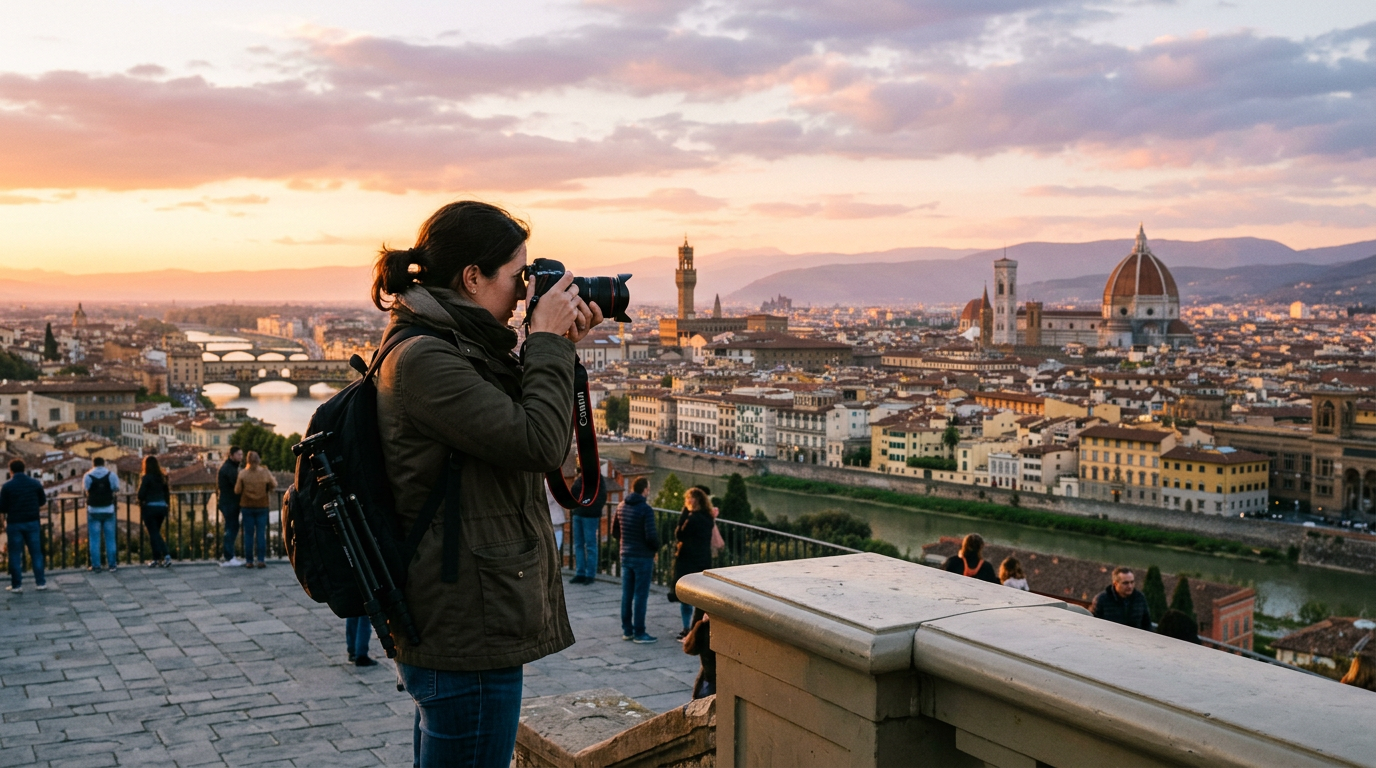
Piazzale Michelangelo is Florence’s signature viewpoint, a broad terrace on the hill south of the Arno that frames the entire historic centre in a single composition. The cathedral dome, the tower of Palazzo Vecchio, the bend of the Arno, the terracotta rooftops of the city: all of these align from this position in a way that is immediately satisfying to photograph.
The difficulty is popularity. Between 10:00 and 20:00 in the tourist season, the piazzale is consistently crowded. Getting to the railing without other visitors in frame requires patience or very good timing.
For photography specifically, the light conditions at this viewpoint work as follows. Morning light from the east falls on the western faces of the cathedral and towers, which face away from the piazzale. This makes morning light less useful for the standard panorama shot. Afternoon light works significantly better: from about 16:00 onwards in summer, the setting sun comes from the west and illuminates the historic centre from roughly the direction you are looking, giving the buildings dimension and warmth.
The golden hour and blue hour in summer run from approximately 19:30 to 20:30. Arrive by 18:30 to secure a position at the railing. The sky colour during the 10 to 15 minutes immediately after sunset is the most dramatic and changes quickly.
To reach the piazzale: bus 13 runs from Lungarno Pecori Giraldi and takes about 10 minutes. The walk up from Porta San Niccolo takes 15 to 20 minutes through a pleasant residential street.
Elevated viewpoints that most visitors miss
Piazzale Michelangelo is the obvious choice, but it is not the only elevated position from which to photograph Florence. Several alternatives offer genuinely different compositions.
The Bardini Garden terrace, accessible from Costa San Giorgio, sits slightly higher and further east than the piazzale. The composition shifts meaningfully: you see more of the Oltrarno neighbourhood directly below, and the relationship between Ponte Vecchio and the hills changes angle. The Bardini Garden costs 10 euros to enter (a combined ticket with the Boboli Garden is available). Open 08:15 to sunset, closed Mondays.
The tower of Palazzo Vecchio places you inside the city rather than on its periphery, at 94 metres above Piazza della Signoria. Looking outward from the tower, the terracotta rooftops of the historic centre spread in every direction below you. This is a completely different photographic experience from any of the hill viewpoints: you are inside the subject rather than looking at it from outside. Entry costs 12.50 euros and timed booking is advisable in high season.
The Forte di Belvedere, the 16th-century fortification between the Boboli Garden and Piazzale Michelangelo, is open when it hosts exhibitions. The bastion at the top of the fortification is one of the least crowded elevated viewpoints in the city and gives you a view slightly different from both the piazzale and the Bardini terrace. Entry price varies depending on the current exhibition.
The Uffizi terraces on the second floor are accessible to museum visitors and provide a direct view of the Palazzo Vecchio tower against the Florentine roofscape. No additional cost beyond museum entry.
The most photogenic streets and when they work
Florence’s medieval streets are extraordinary photographic subjects at the right time of day. The key variable is light. The narrow streets are deeply shaded for most of the day and then briefly and dramatically illuminated when the sun reaches the correct angle.
Via dei Tornabuoni is the city’s most elegant street, lined with Renaissance palaces and high-end boutiques. The best time to photograph it is early morning, from 07:00 to 09:00, when the shops are closed and the low-angle light falls directly on the stone facades. After 10:00, the street fills with pedestrians, delivery trucks, and commercial activity.
Borgo degli Albizi runs east from Via del Proconsolo and is defined by medieval tower houses and a consistent building height that creates a strong corridor effect when photographed from one end toward the other. It works best in late afternoon when the low sun from the west travels the full length of the street.
Via dei Servi connects Piazza del Duomo to Piazza Santissima Annunziata. Standing at the northern end and looking south, you have a framed view of Brunelleschi’s dome at the far end of a long, straight perspective. This is one of the most composed views in Florence and works best in the early morning before the street is busy.
Piazza della Passera in Oltrarno is a small, domestic-scale square that offers a contrast to the grandiose public spaces of the historic centre. The buildings are working residential architecture. In the early morning it is usually empty, and the light at that hour is soft and even.
Working with the light in Florence
Understanding light in Florence means understanding the city’s orientation. Florence runs roughly east to west along the Arno. The historic centre is on the north bank; Oltrarno is on the south.
In the morning, south-facing facades on the north bank of the Arno receive direct light. The river frontage, the Lungarno buildings, and the northern side of the cathedral are all well lit from 07:00 to 10:00 in summer. This is the best time to photograph the Arno from the north bank, with the light falling across the Ponte Vecchio and the Oltrarno buildings behind it.
In the afternoon, the north-facing facades of Oltrarno receive direct light, and the south side of the cathedral and the Ponte Vecchio light up beautifully from the west. The period from 17:00 to 19:00 in summer is the best window for photographs taken from the south bank looking north toward the historic centre.
For interior photography in churches and museums: the light inside Florentine religious buildings is directional and low, coming from high windows and often supplemented by candles or artificial spotlights. A camera that handles low-light conditions well is necessary for sharp results. Most Florentine museums and churches prohibit flash photography, and tripods require advance permission in almost every case.
The golden hour in July and August runs from approximately 19:30 to 20:30. In September and October it shifts earlier, to around 18:00 to 19:00, as the days shorten. These windows apply to almost every outdoor location described in this article.
Camera gear worth bringing
For most travel photography in Florence, a modern mirrorless camera with a standard zoom lens covers the vast majority of situations. The range from 24mm to 70mm (full-frame equivalent) handles street photography, interiors, and the panoramic viewpoints equally well.
A wide-angle lens is useful for narrow streets where you cannot step back far enough to include the full height of a building. A telephoto is useful at Piazzale Michelangelo for pulling in the cathedral dome separately from the panoramic composition.
For smartphone photography: the city is well suited to it. The compressed perspective of most phone cameras works well for street scenes, and the computational photography in current flagship phones handles the low-light interiors better than you might expect. A small portable tripod or a grip with a phone mount is worth having for the blue-hour shots at Piazzale Michelangelo, where the changing sky requires a longer exposure.
Where to Stay in Florence
The Key is at Via Cittadella 22, five minutes on foot from Santa Maria Novella station in Florence. Via dei Tornabuoni, one of the best streets for early-morning photography, is about 10 minutes on foot from the guesthouse. The Lungarno riverbank, ideal for both morning and late-afternoon photography, is roughly 15 minutes south through the centre. For the hill viewpoints: tram T2 from the station to the centre, then bus 13 to Piazzale Michelangelo, takes about 25 minutes total. Full details at The Key.