Dante Florence Places to Visit: Walking Through His World
Trace the Dante Florence places to visit on foot: the Baptistery, Casa di Dante, Santa Croce, and the medieval streets where the poet was born and exiled.
Following Dante through the streets of Florence
Dante Alighieri spent the first half of his life in Florence. Born in 1265, probably in the neighbourhood now covered by the streets around Via Dante Alighieri, he was educated in the city, baptised in the Baptistery of San Giovanni, experienced his famous childhood encounter with Beatrice Portinari near the Arno, served in the Battle of Campaldino in 1289, and entered Florentine political life as a member of the Council of One Hundred.
In 1302, while on a diplomatic mission to Rome, he was convicted of corruption and political offenses by his opponents in Florence and sentenced to a fine, confiscation of his property, and permanent exile. He never saw the city again. He died in Ravenna in 1321.
The paradox at the heart of any Dante itinerary in Florence is that the city expelled him and then, centuries later, built a monument to him inside its finest church. The medieval streets he walked are still largely there, though rebuilt and widened in places. The Baptistery is still there, essentially unchanged. Walking this part of Florence with the Commedia in mind is not nostalgic tourism. It is an encounter with the geography that shaped one of the foundational works of European literature.
Casa di Dante: what you actually see
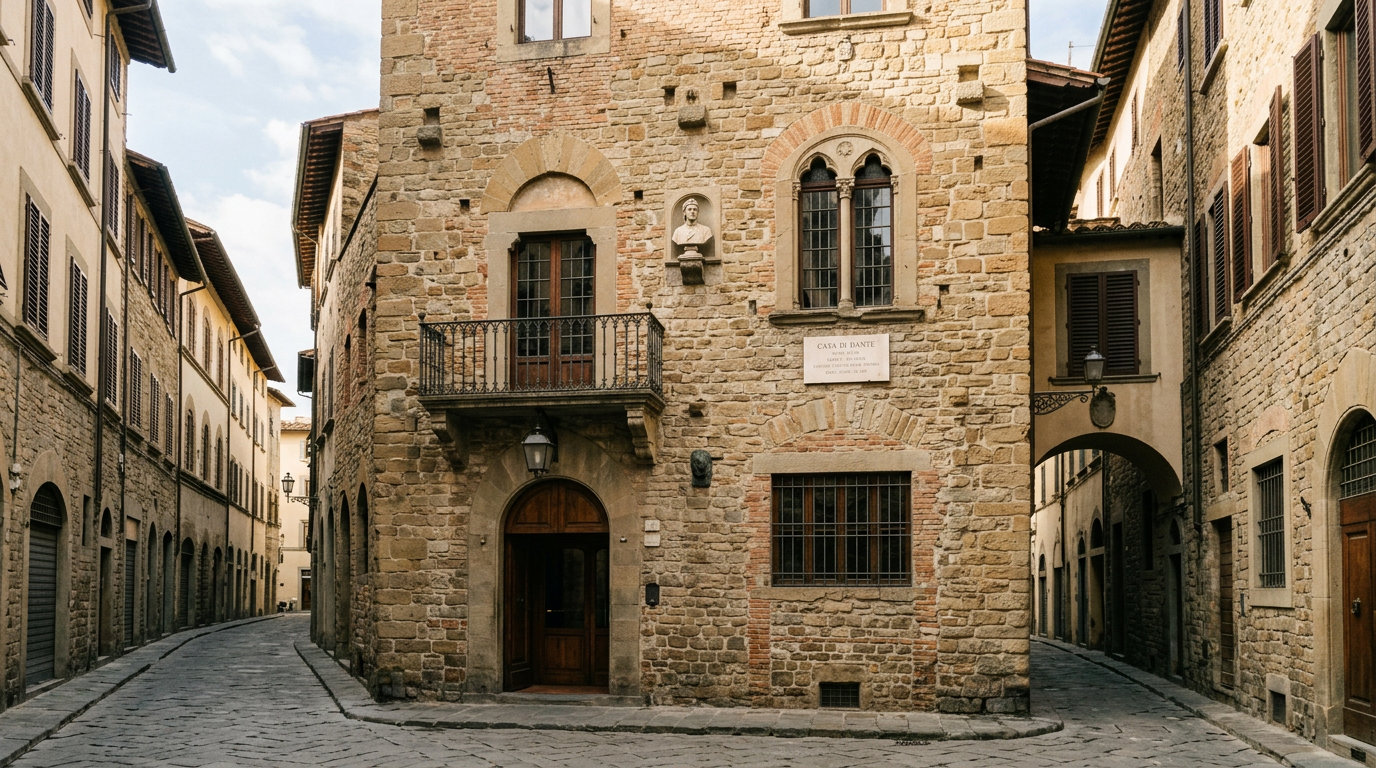
The museum at Via Santa Margherita 1 is routinely described as the “house of Dante.” That description needs immediate qualification. The building was constructed in the early 20th century, not the medieval period. It was built on a site that scholars believed was close to the area where Dante’s family owned property, but there is no continuous chain of evidence linking it to the poet’s actual residence. It was designed from the start as a museum rather than a restored family home.
With that said, the museum merits a visit of about 45 to 60 minutes, particularly if you arrive with some prior knowledge of the Commedia or Florentine medieval history. The permanent exhibition explains the political geography of 13th-century Florence with particular clarity: the conflict between the Guelph and Ghibelline factions that defined Florentine politics during Dante’s lifetime, the social hierarchy of guilds and great families, and the physical layout of the medieval city before the 19th-century rebuilding.
A separate section is devoted to the Commedia itself, covering its structure across the three canticles, the major figures Dante encountered in each realm, and the literary and theological framework within which it was composed. For readers who know the poem well, this section confirms rather than teaches. For readers who do not, it provides a useful entry point.
Entry costs approximately 4 euros for adults. The museum is open Tuesday to Sunday from 10:00 to 18:00, closed Mondays.
Before leaving the immediate area, spend 10 minutes in the small church of Santa Margherita dei Cerchi, immediately beside the museum. Entry is free. The church is traditionally associated with Beatrice Portinari, the woman Dante loved and immortalised across his writing from the Vita Nuova to the Paradiso. Visitors have left messages addressed to Beatrice in a small basket inside the church for decades. The practice began spontaneously and has continued without any institutional encouragement.
The Baptistery of San Giovanni
Few buildings in Florence carry the weight of Dante’s direct reference that the Baptistery does. He calls it his “beautiful San Giovanni” in Inferno, Canto XIX, and the building clearly held profound significance for him as the site of his own baptism and the religious centre of the community that later expelled him.
The Baptistery on Piazza del Duomo predates the Duomo itself by several centuries. The current structure is largely 11th and 12th century in construction, though elements may go back to late antiquity. The exterior’s alternating bands of white Carrara marble and dark green marble from Prato follow a pattern that defines the visual identity of Romanesque Florence. The same colour scheme appears at San Miniato al Monte and, later, at Santa Croce.
The interior mosaic ceiling is the visual climax of the building. Completed during the 13th century, it covers the entire octagonal dome in scenes from the Old and New Testament, including a vast central figure of Christ in Judgement that Dante would have studied with attention during the decades when he was forming the theological architecture of the Commedia. The connection between this mosaic and the imagery of the Inferno is not speculative. It is direct.
Entry costs 5 euros and is included in several combined cathedral complex tickets. The Baptistery is open Monday to Saturday from 08:15 to 19:15, and Sunday from 12:00 to 19:15. Arriving before 10:00 on a weekday significantly reduces the crowds.
The famous gilded bronze doors by Ghiberti that face the cathedral date from 1401 to 1452 and were completed after Dante’s death. The south doors by Andrea Pisano, finished in 1336, were made within living memory of the poet and represent the building as it would have been known to people who remembered him.
Santa Croce: the monument without a body
Dante died in Ravenna on 14 September 1321, in the service of Guido Novello da Polenta, lord of Ravenna, who had given him refuge in the final years of his exile. He was buried there. Ravenna has consistently refused all Florentine requests to transfer the remains to Florence, a refusal that has stood through diplomatic pressure, political negotiation, and centuries of appeals. The bones remain in Ravenna, and there is no realistic prospect of that changing.
Florence’s response was a cenotaph. The monument inside the Basilica of Santa Croce, completed in 1829 to a design by the sculptor Stefano Ricci, is a full-scale marble tomb with allegorical figures representing Poetry, History, Philosophy, and Italy. It occupies a place in the main nave beside the actual tombs of Michelangelo, Galileo, Machiavelli, and Ghiberti, which gives it the visual authority of a genuine burial site.
Understanding what you are looking at, a monument to the fact of exile and never-reconciled absence, makes the cenotaph considerably more interesting than it might otherwise seem. The Florentines who built it were not simply commemorating a poet. They were acknowledging, 500 years late, that the city had expelled its greatest writer for political reasons and never permitted him to return.
Santa Croce is open Monday to Saturday from 09:30 to 17:30, and Sunday from 12:30 to 17:30. Entry is 8 euros for adults. The Pazzi Chapel in the cloister, one of Brunelleschi’s most accomplished spaces, is included in the same ticket.
A route through medieval Florence
The streets linking the Baptistery, the Casa di Dante, and Santa Croce constitute one of the most historically dense walks in the city. The route covers roughly 2.5 kilometres and can be done in 90 minutes without visits, or spread across a morning with stops.
Begin at the Baptistery. Stand inside and look at the mosaic ceiling for at least 15 minutes. The scale and complexity reward sustained attention in a way that a quick pass does not.
Walk south along Via dello Studio, then east on Via del Proconsolo. The Bargello at Via del Proconsolo 4 is Florence’s sculpture museum, housed in a building from 1255 that served first as the seat of the city’s chief magistrate and later as a prison. It is the oldest surviving public building in Florence. Entry costs 10 euros and is worthwhile for the Donatello bronzes and the courtyard, which was formerly an execution ground.
Continue south to Via Dante Alighieri and walk through the neighbourhood that surrounds what remains of the medieval street plan. The streets here are narrow, and the buildings, though largely rebuilt, follow the medieval lot lines. The Casa di Dante museum is on this route, and the church of Santa Margherita dei Cerchi is beside it.
From there, continue south to Piazza Santa Croce and the basilica. The section between the Bargello and Santa Croce preserves some of the most intact medieval urban fabric in the city. The buildings along Borgo dei Greci are largely 13th to 15th century in construction and the street scale is proportionate to a pre-modern city.
Where to Stay in Florence
The Key stands at Via Cittadella 22, a five-minute walk from Santa Maria Novella station. The medieval quarter around Via Dante Alighieri is roughly 20 minutes on foot from the guesthouse, following the route through the centre past the Duomo. Santa Croce is about 25 minutes on foot or a short journey on bus line C2. Full details at The Key.