Florence Cantuccini: Where to Buy Them and What Makes a Good One
Your complete guide to Florence cantuccini where to buy the best, how they differ from generic biscotti, how to pair them with vin santo, and what to budget.
What cantuccini are and where they come from
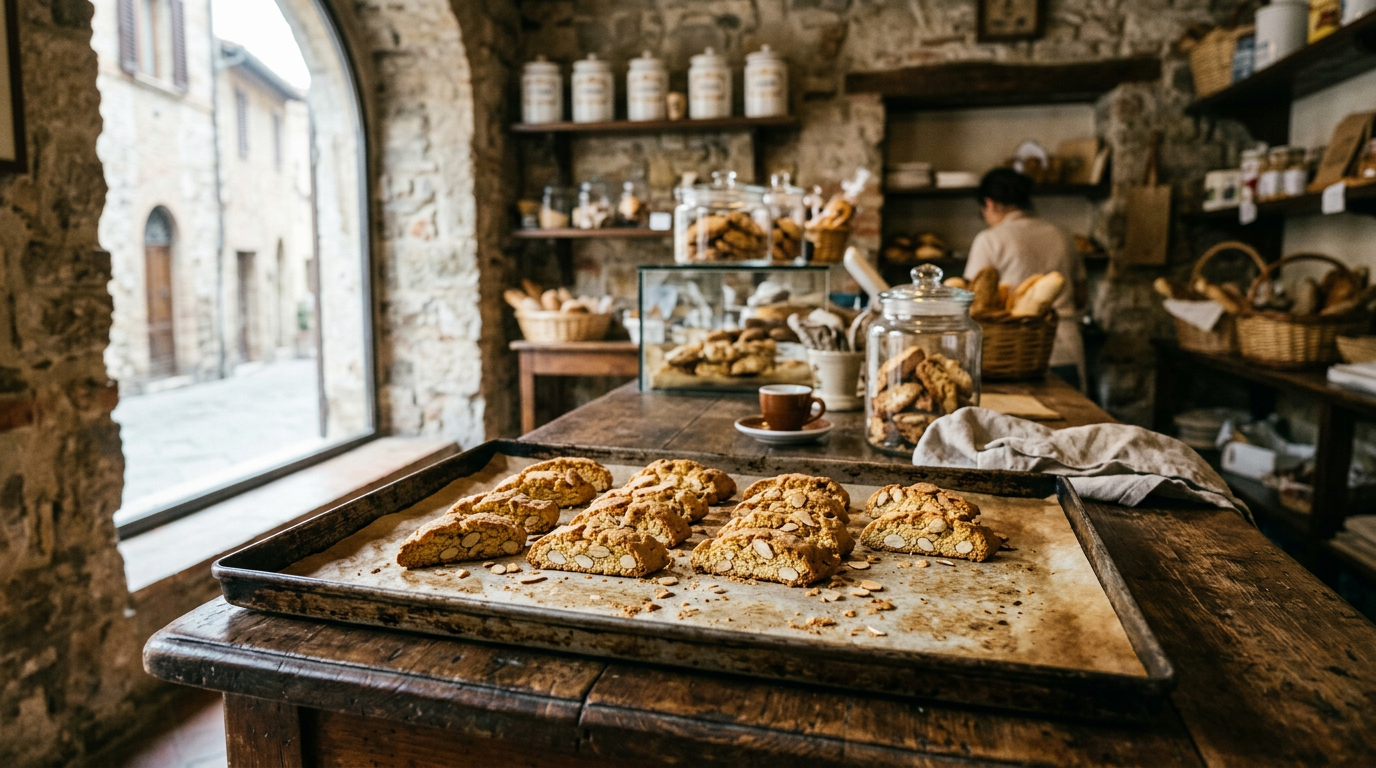
Cantuccini are twice-baked almond biscuits from Tuscany. Small, firm, and very dry, they are cut diagonally from a baked log into finger-shaped pieces and returned to the oven to lose almost all their moisture. The result is a biscuit with a concentrated almond flavour and a shelf life of several weeks without spoiling.
The technique of double-baking predates the Tuscan version by a long stretch. The Latin term biscoctus, meaning cooked twice, is the root of both the English “biscuit” and the Italian “biscotto.” Roman soldiers and sailors relied on twice-baked bread precisely because it survived long journeys without going stale. The Tuscan almond version developed during the medieval and Renaissance periods.
The clearest documented origin for the modern cantuccino comes from a Prato baker named Antonio Mattei, who began producing them commercially in 1858. His shop on Via Ricasoli in Prato, a town approximately 17 kilometres north of Florence by train, is still operational and is widely regarded as the benchmark for the original version. Getting there from Florence requires only a 25-minute train ride from Santa Maria Novella station.
Cantuccini versus cantucci: a practical distinction
The two terms are used interchangeably by most Tuscan producers and by most Tuscans themselves, but a distinction exists and is worth understanding.
Cantucci (singular: cantuccio) is the older term, referring to the thick, hard, twice-baked almond biscuit in the Prato style. The word cantuccio describes a corner or a cut piece, which refers to the diagonal cut made when slicing the baked log.
Cantuccini is the diminutive. In practice, it typically describes slightly smaller or lighter versions of the same biscuit, though many producers use the terms interchangeably on their packaging without any difference in the product.
In Florence you will encounter both words. The useful thing to know is that neither term guarantees quality. What matters is the recipe and the method. A proper cantuccio contains whole blanched almonds, butter or lard, eggs, flour, sugar, and a small amount of anise or vanilla. It is baked twice until completely dry throughout.
Be cautious with products labelled cantuccini that contain chocolate chips, pistachio, lemon zest, dried fruit, or other additions. These are commercial variations aimed at the tourist market. They may be pleasant, but they are not the original biscuit.
Where to buy them in and around Florence
Biscottificio Antonio Mattei in Prato, at Via Ricasoli 20, is the definitive source. It is not in Florence, but the train journey takes around 25 minutes from Santa Maria Novella station to Prato Centrale, and the short walk from the station to the shop is straightforward. Mattei’s cantuccini are austere in the best sense: dry, intensely almond-forward, produced according to a recipe that has not changed substantially since the 19th century. If you take the biscuit seriously, the trip is worth making.
In Florence proper, several bakeries and pastry shops produce or stock cantuccini of genuine quality.
Il Forno di Stefano Galli, at Via delle Caldaie 34r in Oltrarno, is a working bakery that makes cantuccini using traditional methods. The shop does not advertise heavily and serves primarily neighbourhood residents. A bag of roughly 250 grams costs around 4 to 6 euros.
Pasticceria Buonamici, at Borgo degli Albizi 11r, produces cantuccini in-house alongside a range of traditional Florentine pastries. The production kitchen is partially visible from the shop floor, and the biscuits are sold fresh alongside seasonal confections.
Mercato Centrale, at Via dell’Ariento, has several ground-floor stalls selling Tuscan food products, including cantuccini from various producers. Quality varies between stalls. Look for bags where the biscuits are clearly dry and golden rather than pale and soft.
For presentation-quality packaging, Migone Confetture e Biscotti at Via dei Calzaiuoli 85r stocks Tuscan biscuits and confections in presentation tins and boxes. Prices are higher than a bakery, but the packaging is appropriate for bringing home as a gift.
Vin santo: the traditional pairing
Cantuccini are served with vin santo, and this is not arbitrary. The biscuit is specifically designed to be dipped in the wine. The hard, dry texture softens in the liquid, and the almond flavour combines with the sweetness of the wine in a way that eating the biscuit alone does not achieve. Arriving at the end of a meal in Tuscany and ordering cantuccini without vin santo is technically possible, but misses the point of the combination.
Vin santo (literally “holy wine”) is made from Trebbiano and Malvasia grapes that are partially dried after harvest. The grapes are spread on racks in well-ventilated rooms for several months. Drying concentrates the sugars significantly. The resulting must is fermented in small barrels called caratelli and aged for a minimum of three years. Serious producers age it for five to eight years or longer.
The finished wine ranges from moderately sweet to intensely sweet depending on the producer and the vintage. The best examples have flavours of walnut, dried fig, honey, and a distinct nuttiness from the oxidative aging in barrel. The sweetness is balanced by acidity and complexity from the long contact with wood.
In a restaurant, a small glass of vin santo (50 to 75 ml) served with cantuccini costs 5 to 10 euros. For a bottle to take home: quality vin santo from a reputable Tuscan producer costs 20 to 50 euros for a 375 ml bottle at a Florence enoteca. Producers worth looking for include Avignonesi, Isole e Olena, Capezzana, and Fontodi.
Pricing and formats for taking cantuccini home
Cantuccini travel extremely well. Dry, dense, and easy to pack, they are one of the more practical food items to bring back from a Tuscan trip.
Bulk from a bakery: 500 grams costs 7 to 12 euros depending on the shop. This is the most economical format for personal consumption or if you want a large quantity. Properly stored in a sealed container, they keep for two to three weeks.
Packaged in paper bags from artisan producers: bags of 150 to 200 grams from shops like Mattei or the stalls at Mercato Centrale cost 4 to 7 euros. These are appropriate as small gifts without needing elaborate presentation.
Gift boxes and presentation packaging: specialty food shops including Migone offer decorated tins or boxes containing 250 to 500 grams of cantuccini for 12 to 22 euros. The presentation format is designed for gift-giving and protects the biscuits in transit.
Combined vin santo and cantuccini sets: some enoteca shops assemble boxes containing a half-bottle of vin santo alongside a bag of cantuccini. These cost 25 to 40 euros depending on the quality of the wine included.
A note on supermarket cantuccini: Tuscan supermarkets including Coop, Esselunga, and PAM stock several brands at 2 to 4 euros per bag. Quality varies, but several supermarket producers also supply upmarket retailers. If you want cantuccini for personal consumption without the gift packaging, the supermarket is a practical option and not a compromise of principle.
Where to Stay in Florence
The Key is at Via Cittadella 22, five minutes from Santa Maria Novella station in Florence. The train to Prato, for the Mattei shop, departs directly from the station and arrives in about 25 minutes. The Mercato Centrale and several Florentine pastry shops stocking quality cantuccini are within a 15-minute walk of the guesthouse. Full details at The Key.