Florence Leather Artisans: How to Find Real Workshops and What to Buy
The complete story of Florence leather artisans workshops, from the Scuola del Cuoio to Oltrarno ateliers, with advice on spotting genuine handmade goods.
A craft with genuine roots
Florence’s connection to leather craftsmanship goes back to the 13th century. Tanning and leather-working were among the city’s most economically significant industries through the medieval and Renaissance periods. The Arno river, which bisects the city, was essential to the tanning process: the hides were soaked and processed in the river’s water, and the tanneries clustered along its banks.
The industrial revolution and the subsequent rise of factory production made handmade leather goods increasingly difficult to sustain commercially. The number of working Florentine leather craftspeople declined sharply through the 20th century. What remains is a smaller community of artisans, concentrated in specific parts of the city, who continue to produce leather goods by hand using inherited methods and hand tools.
The tourist market has complicated things considerably. Goods labelled “Florentine leather” or “made in Florence” are sold in enormous quantities throughout the city’s tourist zones, particularly around the Duomo, on Ponte Vecchio, and at the San Lorenzo leather market stalls. The majority of these goods have no connection to Florentine craft tradition. Many are machine-made in factories in China or Eastern Europe and imported specifically for the tourist trade.
Understanding this distinction is essential before spending money on anything described as handmade.
The Scuola del Cuoio at Santa Croce
The Scuola del Cuoio, or Leather School, at Via San Giuseppe 5r within the complex of the Basilica of Santa Croce, is one of the few places in Florence where visitors can observe leather goods being made and buy them in the same building.
The school was founded in 1950 by Florentine monks in collaboration with two master leather artisans. The original purpose was practical: to provide leatherworking training to young people orphaned by the Second World War. The school has operated continuously since that time and now functions as a working atelier and shop simultaneously. Apprentices and experienced craftspeople work at benches visible from the shop floor. The product you purchase was made in the building you are standing in.
The range covers wallets, bags, belts, gloves, desk accessories, and notebooks with Florentine leather covers. Prices are substantially higher than anything you will find at a market stall, and they accurately reflect the labour and materials involved in handmade production. A hand-stitched leather wallet costs 60 to 130 euros depending on size and complexity. A shoulder bag is 200 to 500 euros.
Access is through Via San Giuseppe, via an entrance separate from the basilica ticket office. Entry to the shop and workshop viewing area is free. Opening hours are Monday to Saturday, 10:00 to 18:00. In summer, hours extend to 18:30. The staff are knowledgeable and generally willing to explain the production process and material choices without any sales pressure.
Independent workshops in Oltrarno
The Oltrarno neighbourhood, on the south side of the Arno, has historically been Florence’s artisan quarter. Bookbinders, gilders, furniture restorers, picture framers, and leather workers have occupied this neighbourhood for centuries. The concentration has diminished but has not disappeared. A number of working leather workshops remain active in the streets around Via Maggio, Via dei Bardi, and the area near Piazza della Passera.
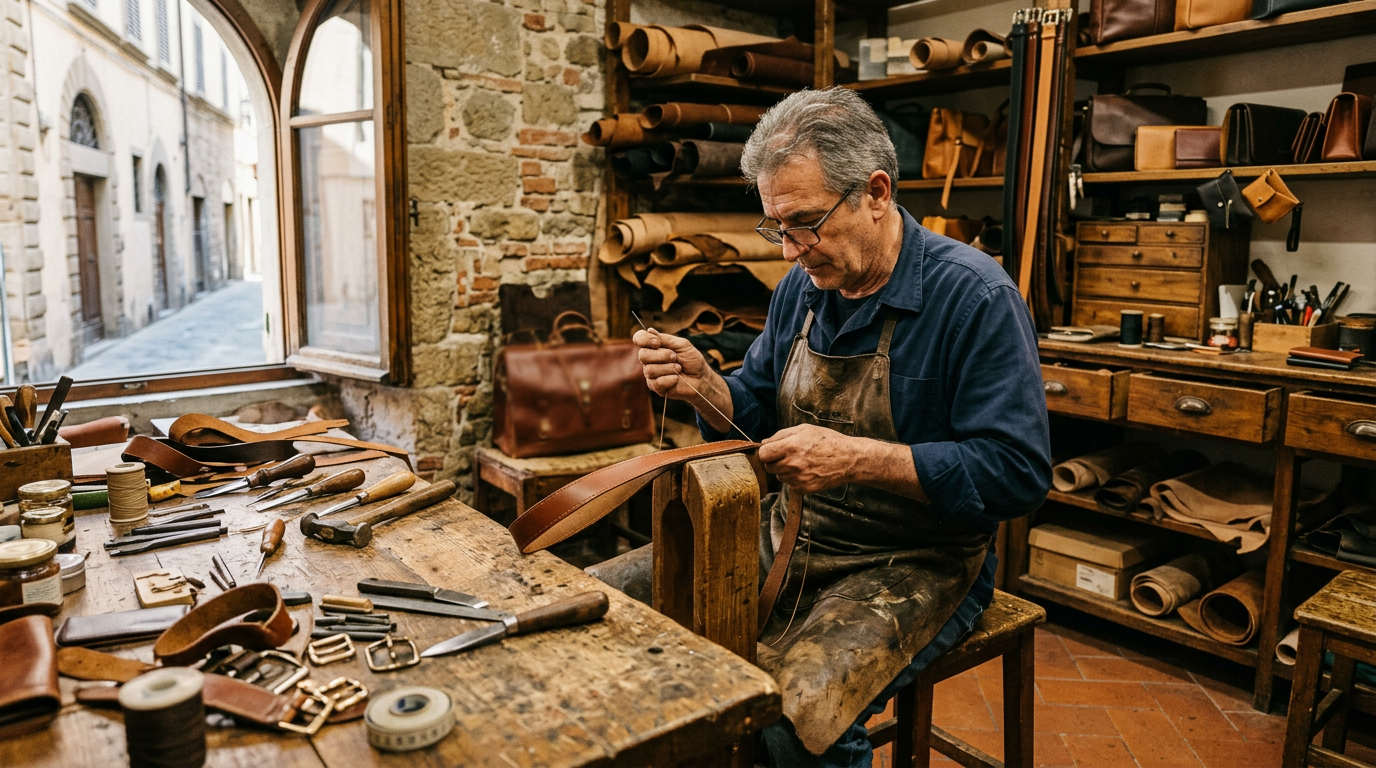
Finding a working workshop requires paying attention to sensory cues rather than following signs. The smell of leather and tanning compounds is distinctive and detectable from the street. An open door during working hours is typical in Florence’s artisan workshops; many craftspeople work with the door open for light and ventilation.
The visual markers of a genuine workshop are also clear. You should see tools in use, material off-cuts on the workbench, and objects in various stages of completion. If every item is behind glass and the person present is stationed behind a counter, you are in a shop. If there is a workbench with tools laid out and someone is actively making something in front of you, you are in a workshop.
Buying directly from a workshop rather than through a retail intermediary has practical advantages beyond authenticity. A craftsperson making wallets may be able to add a monogram, change a colour, alter the proportions of a standard design, or make a custom piece to a specification you describe. It is worth asking. Most independent leather artisans in Oltrarno are not operating at full commercial capacity and welcome this kind of conversation.
How to tell handmade from machine-made leather
Several straightforward physical tests help distinguish genuinely handmade leather goods from machine-made alternatives sold at similar-looking shops.
Stitching: handmade saddle stitching uses two needles and a waxed linen thread, passed through each hole from opposite sides simultaneously. Under close inspection, the stitches sit at a slight angle and have a slight variation in tension from one to the next. Machine stitching is perfectly uniform: every stitch is identical because the process is mechanically controlled. This regularity is, paradoxically, the tell.
Edges: on a handmade piece, the cut edges of the leather are burnished or treated individually by hand. You can see the slight variations in coverage and pressure. Machine-finished edges are perfectly uniform and consistent all the way around the piece.
Weight and texture: handmade goods tend to use thicker, full-grain leather because it responds better to hand tools and develops a characteristic patina over years of use. A wallet or belt that feels firm and slightly stiff when new, and that will gradually conform to your habits, is likely full-grain leather. Goods that feel immediately soft and lightweight are often split leather with a bonded surface coating.
Price as a signal: genuine handmade leather goods in Florence from quality hides have a production cost that must be reflected in the price. A handmade wallet for less than 50 euros is unlikely to be what it claims. A handmade bag below 150 euros should prompt questions. These are not absolute rules, but they are reasonable starting reference points.
Buying guide: what to spend and on what
A practical overview of pricing for those planning to buy.
Wallets and cardholders: from a genuine artisan, 60 to 130 euros for a bi-fold or card wallet in full-grain leather. Passport holders and travel wallets, which require more leather and more labour, typically cost 80 to 180 euros.
Belts: 50 to 120 euros from a working artisan. Wider belts in thicker leather sit toward the upper end of this range.
Bags and shoulder bags: 200 to 600 euros for a handmade everyday bag. Larger or more structurally complex pieces cost more in proportion to the additional work and material. This is a significant purchase; confirm the item is genuinely made in the workshop before deciding.
Gloves: Florence has a specific history of leather glove production. A pair of handmade leather gloves costs 60 to 150 euros depending on the leather used and whether the gloves are lined.
Notebooks and stationery: leather-covered notebooks with marbled paper interiors are available from 15 to 50 euros depending on size and finish. This is one of the more accessible artisan categories and among the most practical gift options in the city.
For comparison: the San Lorenzo leather market stalls and the tourist-facing shops near the Duomo typically sell wallets for 15 to 30 euros. These are almost universally machine-made from bonded leather or split leather with a surface coating. They are not representative of Florentine craft, and while they may look reasonable in the short term, they will not develop the qualities that full-grain handmade leather acquires over years of use.
Where to Stay in Florence
The Key is at Via Cittadella 22, five minutes on foot from Santa Maria Novella station in Florence. The Scuola del Cuoio at Santa Croce is about 25 minutes on foot through the historic centre. The Oltrarno workshops are accessible across the Arno, roughly 20 to 25 minutes from the guesthouse. Both areas are reachable without public transport for visitors based near the station. Full details at The Key.