Finding the Best Aperitivo in Florence: A Neighbourhood by Neighbourhood Guide
Everything you need to know about enjoying the best aperitivo in Florence, from Negroni history to honest price breakdowns and the right neighbourhoods.
How aperitivo works in Florence
Florence and Milan both have an aperitivo culture, but the two cities have arrived at very different versions of it. In Milan, the model is largely buffet-driven: you pay for a drink and gain access to a spread of food. In Florence, the concept is older and rooted in something simpler. You order a drink before dinner, something comes alongside it, and the point is to pause and transition between the afternoon and the evening meal.
That said, Florence has shifted over the past decade. Certain bars now lay out generous plates of food with every order. Others stick to a few olives and a bruschetta. Some have no food offer at all. Knowing what kind of place you are walking into saves you from ordering a Spritz and finding nothing to eat.
The aperitivo window runs from roughly 18:00 to 20:00. Some bars open for it at 17:30, a handful push through to 20:30. Most trattorie begin dinner service at 19:30, so the timing slots in naturally before the meal.
A drink at aperitivo, whether a Negroni, a glass of Chianti, or an Aperol Spritz, typically costs 7 to 12 euros in the majority of bars. That price normally includes something small to eat: olives, a crostino with chicken liver pate, a few crisps, or a bruschetta with tomato.
Neighbourhood breakdown: where to drink
Florence is compact, and the best aperitivo spots are distributed across several distinct areas, each with a different atmosphere and price level.
Oltrarno sits south of the Arno and is historically the less touristy side of the city. The streets around Piazza Santo Spirito are the heart of aperitivo life in this neighbourhood. Several bars ring the piazza and offer outdoor seating from April through October. On weekday evenings, the crowd is predominantly local. On Fridays and Saturdays, it draws a mix of residents and visitors, but retains its character better than most areas in the centre.
San Frediano, which merges into the western end of Oltrarno, has become one of the more interesting parts of the city for drinking over the past several years. Via dei Serragli and the smaller streets running off it have wine bars and cocktail bars that charge fairer prices than the historic centre and draw fewer tourists.
The area around Santa Croce, particularly Via dei Benci and Borgo dei Greci, contains a combination of tourist-facing bars and some genuinely good neighbourhood spots. You need to look more carefully here. Walk away from the piazza itself and the quality improves quickly.
Sant’Ambrogio, to the east of the centre and close to the food market, has a cluster of unfussy wine bars that fill with residents from about 19:00 onwards. Prices here typically run 1 to 2 euros below equivalent options in the tourist-facing parts of the centre.
The Negroni: Florence’s own cocktail
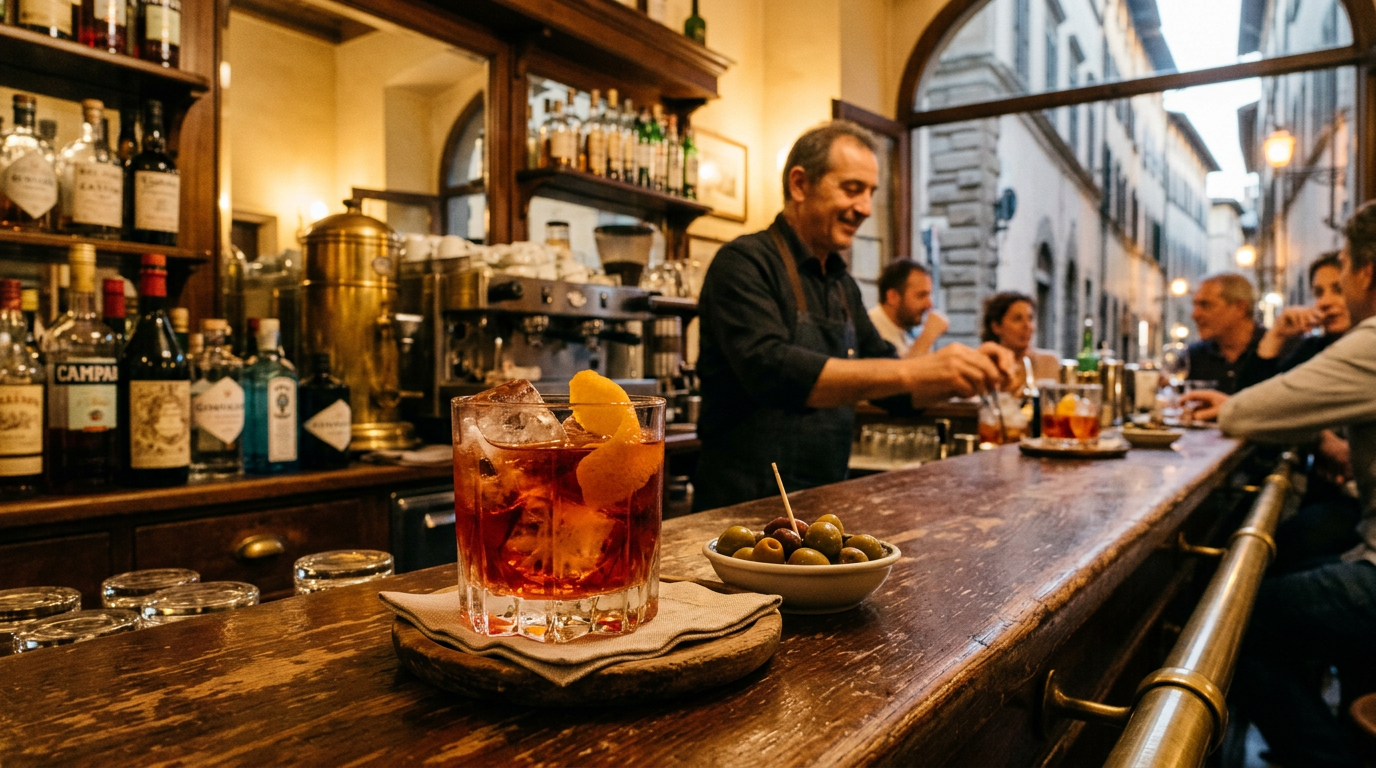
The Negroni has its origin in Florence. The accepted story places the invention in 1919 at Caffe Casoni (near the current Caffe Giacosa on Via della Vigna Nuova), where Count Camillo Negroni asked the barman to replace the soda water in his Americano with gin. The resulting drink became one of the most replicated cocktails in the world and remains central to Florentine bar culture.
A correctly made Negroni is equal parts gin, sweet vermouth, and Campari, stirred with ice and strained into a glass over a large ice cube, finished with a twist of orange peel. The peel is expressed over the surface to release the citrus oils and then used as a garnish. A slice of orange, rather than a peel, is a shortcut.
In Florence, a bar’s Negroni quality functions as a proxy for the overall standard. If the proportions are right, the ice is fresh, and the vermouth is of a known producer, the bar likely takes its drinks seriously across the board.
Look for bars in Oltrarno that stock Italian vermouths from producers like Berto, Cocchi, or Punt e Mes. A bar displaying a selection of vermouth bottles is a good indicator. A proper Negroni costs 8 to 11 euros in most quality bars.
The worst Negronis in the city come from tourist-facing bars near the Uffizi and Piazza della Signoria. The price is often 12 to 14 euros, the proportions are unbalanced, and the vermouth is likely from an anonymous supplier.
Buffet aperitivo: where and when it exists
The Milanese model, a full spread of food included with your drink, exists in Florence but is less widespread than visitors often expect. A few bars run it regularly, though they tend to be positioned slightly away from the main tourist concentrations.
The bars along Via Tornabuoni and around Piazza della Repubblica sometimes offer buffet-style aperitivo evenings, but the drinks start at 12 euros and the food quality is inconsistent. A better approach is to find wine bars that serve cicchetti or stuzzichini, small individual plates brought with each order. Crostini with different toppings, a sliver of pecorino, cured meat, marinated artichoke hearts. This format is common in Oltrarno and in Sant’Ambrogio.
For something more substantial, several enoteca-style restaurants in Oltrarno offer a shared charcuterie and cheese plate alongside wine orders. This is not a buffet, but it is generous. Expect 10 to 15 euros per person for the food, with wine priced separately.
One observation worth noting: bars that have painted “APERITIVO” in large letters across their window are usually targeting passing tourist trade. Bars where the aperitivo offering is chalked on a small board inside, or communicated verbally by the staff, tend to be operating for a regular local clientele.
Tuscan wine at aperitivo: what to order
Florence is inside the Chianti Classico production zone. Ordering a glass of Chianti Classico at aperitivo makes geographical and culinary sense. The wine is Sangiovese-based, dry, lightly tannic, and pairs naturally with the salty snacks that accompany most aperitivo orders.
A wine bar worth visiting is one that maintains a short list of Tuscan wines by the glass. Vernaccia di San Gimignano is one of the oldest white wines documented in Tuscany and drinks well in warmer months. Morellino di Scansano and Vino Nobile di Montepulciano are two red options beyond Chianti that deserve attention.
If the wine list simply says “red” or “white” with no additional information, the wine is almost certainly coming from an anonymous large-production source. It will be drinkable but will not represent the region. Moving on is usually the right call.
Prices for a glass of Chianti Classico run from 5 to 7 euros in most bars. Vermentino or Vernaccia runs around 5 euros. Premium single-estate wines, a Brunello or a Bolgheri red, will be 8 to 14 euros per glass at enoteca-style bars.
Prices and timing at a glance
A clear breakdown helps with planning.
Standard aperitivo drink with something small to eat: 7 to 10 euros in wine bars and neighbourhood spots in Oltrarno and Sant’Ambrogio.
Cocktail aperitivo closer to the historic centre: 9 to 13 euros. The price rises in direct proportion to proximity to Piazza della Signoria and the Duomo.
Wine by the glass at aperitivo: 5 to 8 euros for most Tuscan options.
Generous food accompaniment at an enoteca: 12 to 18 euros per person, not including drinks.
The ideal arrival time if you want outdoor seating is between 18:15 and 18:30. By 19:00 on Fridays and Saturdays, Piazza Santo Spirito and the Via dei Benci area are crowded.
Aperitivo food service at most bars ends around 20:00. Some bars on Piazza Santo Spirito continue serving drinks until 21:30 or later, but without the accompanying food component.
Where to Stay in Florence
The Key is a guesthouse at Via Cittadella 22, five minutes on foot from Santa Maria Novella station. Oltrarno, home to some of the city’s best aperitivo spots, is a 15-minute walk across the river. The Sant’Ambrogio neighbourhood is roughly 20 minutes through the centre. Both areas are reachable on foot from the guesthouse, which keeps evenings simple regardless of bus schedules. Full details at The Key.